
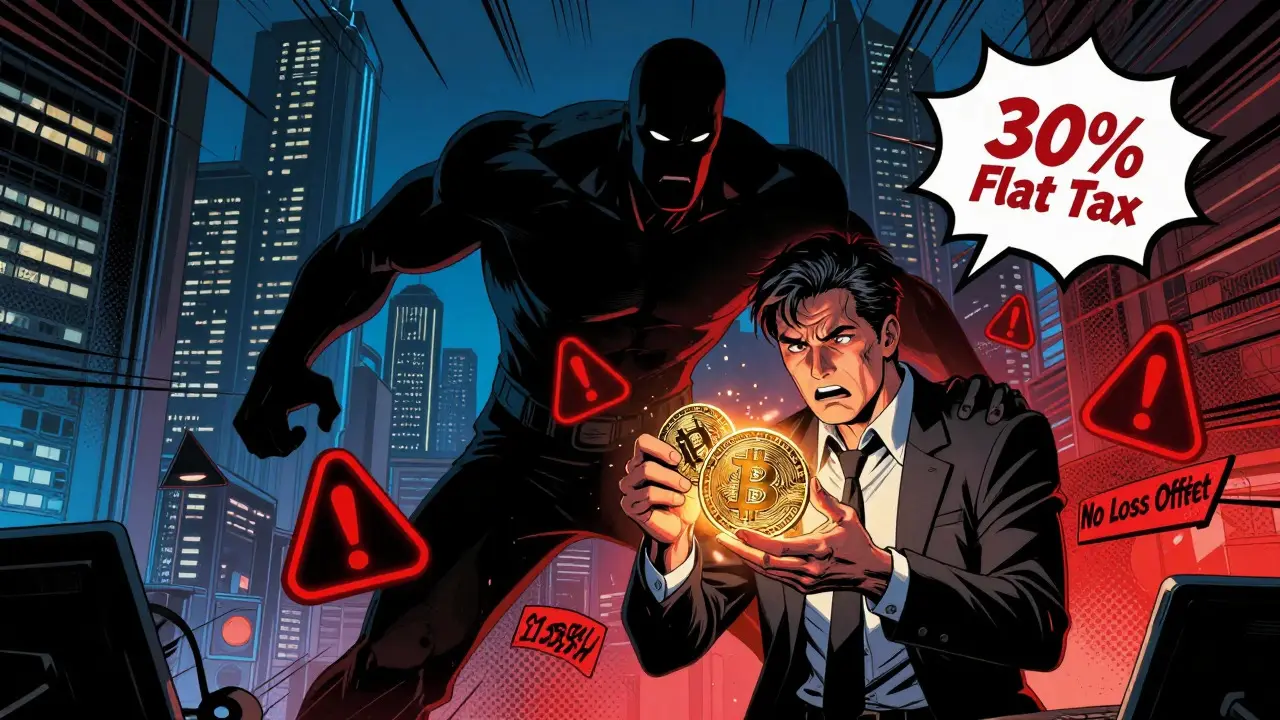
If you hold Bitcoin or Ethereum in India, the government isn’t just watching; it’s taxing every move. Since the financial year 2023-24, India has enforced one of the strictest cryptocurrency tax regimes globally. But here is the catch: while the tax rates are clear, the enforcement mechanisms and specific penalty structures for non-compliance remain a murky grey area that can cost you dearly if you aren't careful.
For many investors, the confusion stems from mixing up Virtual Digital Assets (VDAs) with traditional stocks. Unlike shares where losses offset gains, crypto in India is treated more like lottery winnings. This article breaks down exactly how the Indian crypto tax enforcement framework works in 2026, the new GST implications, and what happens when you fail to report your holdings.
The Core Tax Structure: 30% Flat Rate
At the heart of Indian crypto taxation is Section 115BBH of the Income Tax Act. Introduced in the 2022 budget, this section mandates a flat 30% tax on all profits from the transfer of Virtual Digital Assets. This rate applies regardless of your income slab. Whether you are in the lowest or highest tax bracket, the math remains the same.
Here is why this hurts many traders:
- No Loss Offset: You cannot set off losses from one crypto against gains from another. If you made ₹1 lakh profit on Bitcoin but lost ₹50,000 on Solana, you still pay 30% tax on the full ₹1 lakh gain.
- No Expense Deduction: Transaction fees, gas fees, or mining costs cannot be deducted from your taxable income.
- Calculation Method: The tax is calculated as (Sale Price - Cost of Acquisition). The cost basis is determined at the time of acquisition.
This structure treats crypto gains similarly to gambling or lottery winnings, signaling the government’s cautious stance. It effectively discourages high-frequency trading because the tax burden erodes margins quickly without the safety net of loss adjustments.
TDS Under Section 194S: The 1% Deduction
To ensure compliance, the government introduced Section 194S, which mandates a 1% Tax Deducted at Source (TDS) on crypto transactions. This is not an additional tax but an advance payment toward your final tax liability.
How it works in practice:
- You sell crypto worth ₹1,00,000 on an exchange.
- The exchange deducts ₹1,000 (1%) before crediting the remaining amount to your wallet or bank account.
- This ₹1,000 is deposited directly with the government by the exchange.
This mechanism creates a digital trail. Every transaction is reported to the Income Tax Department, making it nearly impossible to hide large-scale trading activity if you use regulated exchanges. However, peer-to-peer (P2P) transactions or decentralized finance (DeFi) swaps often bypass this system, creating a significant enforcement gap.
New GST Rules for Crypto Platforms (Effective July 2025)
A major shift occurred in mid-2025 with the introduction of Goods and Services Tax (GST) on crypto services. From July 7, 2025, an 18% GST applies to all services rendered by cryptocurrency platforms to Indian users.
This change impacts how much you actually earn. Previously, some fees were ambiguous. Now, under Notification No. 11/2017-Central Tax, platforms classified as Online Information and Database Access or Retrieval (OIDAR) services must charge GST on:
- Spot and margin trading fees
- Derivatives trading charges
- Staking rewards and custody fees
- Wallet management and KYC services
- Deposit and withdrawal charges
Crucially, these platforms must register for GST even if their turnover is below the standard ₹20 lakh threshold. This means the 18% GST is likely added on top of the trading fee, increasing the overall cost of entry for retail traders. For example, if an exchange charges a 0.1% trading fee, you now pay that fee plus 18% GST on that fee.

Filing Returns: Schedule VDA
Compliance requires accurate reporting. You cannot ignore crypto income in your annual returns. Depending on your income source, you must file either ITR-2 (for capital gains) or ITR-3 (if treating crypto as business income, though the 30% flat rate usually overrides business deductions).
Both forms include a dedicated Schedule VDA. This schedule requires you to disclose:
- Total value of VDAs held during the financial year.
- Details of transfers (sales) including date, counterparty, and consideration received.
- Gains computed under Section 115BBH.
Failing to mention crypto holdings in Schedule VDA is a red flag. With data sharing between exchanges, banks, and the tax department, mismatches are easily detected during automated scrutiny.
Enforcement Gaps and Penalties
While the tax rules are rigid, the specific "penalty" for late filing or underreporting crypto follows general Income Tax Act provisions rather than a unique crypto-specific fine structure. Here is what you face:
| Violation Type | Consequence | Authority |
|---|---|---|
| Late Filing of ITR | Penalty under Section 234F (₹1,000 to ₹5,000 depending on income) | Income Tax Dept |
| Underreporting Income | Penalty of 50% to 200% of tax evaded under Section 270A | Income Tax Dept |
| Failure to Furnish Information | Penalty up to ₹10,000 per instance under Section 271FA | Income Tax Dept |
| Black Money Investigation | Confiscation of assets + criminal prosecution under Prevention of Money Laundering Act (PMLA) | ED / CBDT |
The Central Board of Direct Taxes (CBDT) initiated consultations in August 2025 with crypto companies. They asked critical questions about whether the 1% TDS is excessive and if offshore exchanges enjoy unfair advantages. This suggests the current enforcement might be struggling with liquidity issues caused by the heavy tax burden. However, until new laws pass, the existing penalties for income tax evasion apply fully to crypto.

The Offshore Exchange Challenge
A significant loophole exists for users trading on offshore exchanges not registered in India. These platforms do not deduct 1% TDS. While this saves money upfront, it increases risk. The CBDT is actively monitoring cross-border flows. If you move large sums to offshore wallets, the Reserve Bank of India (RBI) and banking partners may flag transactions for Anti-Money Laundering (AML) checks.
The Supreme Court’s 2020 ruling prevented a complete banking ban, but banks remain cautious. Many have restricted crypto-related transactions due to regulatory pressure. This makes funding offshore accounts difficult and traceable.
Future Outlook: Will Rules Change?
The landscape is evolving. The CBDT’s review process indicates recognition that the current 30% tax may have driven volume overseas. Potential changes could include:
- Allowing loss offsets to encourage domestic trading.
- Clarifying the status of DeFi and P2P transactions.
- Stricter reporting requirements for offshore entities doing business with Indians.
Until comprehensive crypto legislation replaces the current patchwork of tax amendments, assume the worst-case scenario: full disclosure and full payment of taxes.
Is crypto legal in India in 2026?
Yes, owning and trading crypto is legal, but it is not recognized as legal tender. The Supreme Court lifted the banking ban in 2020. However, it is heavily taxed under Section 115BBH, and regulatory bodies like SEBI and RBI continue to monitor its impact on financial stability.
Do I pay tax on crypto gifts?
Yes. Receiving crypto as a gift is considered a 'transfer' under the law. The recipient pays the 30% tax on the fair market value of the crypto at the time of receipt. There is no exemption for gifts from relatives unless they fall under specific general gift exemptions, but crypto's classification as VDA makes this complex and generally taxable.
What happens if I don't declare my crypto holdings?
If caught, you face penalties under Section 270A for underreporting income, which can be 50% to 200% of the tax evaded. Additionally, if the amounts are substantial, it could trigger investigations under the Prevention of Money Laundering Act (PMLA), leading to asset confiscation.
Does the 18% GST apply to buying crypto?
The 18% GST applies to the *services* provided by the platform, such as trading fees, withdrawal fees, and staking rewards. It does not apply to the price of the crypto asset itself. So, if you buy $1,000 of Bitcoin, you don't pay GST on the $1,000, but you do pay GST on the exchange's commission fee.
Can I claim losses from crypto trading?
Currently, no. Under Section 115BBH, losses from Virtual Digital Assets cannot be set off against other income (like salary or interest) or even against gains from other cryptocurrencies. Each gain is taxed in isolation, making loss-making trades financially punitive.
Harman Singh
July 31, 2026 AT 11:58man this is just another way for the gov to drain our pockets. i mean seriously, 30% flat rate? thats insane. why do they always target us small investors while the big whales escape? its so unfair and exhausting dealing with all these new rules every year. feels like we are being punished for even trying to save money. 😩
Jack Delasquez
July 31, 2026 AT 17:09Hey guys! Just wanted to say keep fighting the good fight out there! The system might be tough but we got this! Dont let the taxes scare you away from your dreams! Stay positive and keep stacking sats! 💪🚀
Subhash Kashyap Dm
August 2, 2026 AT 11:49the real issue here is the offshore loophole which the elite exploit while retail gets crushed by TDS and GST. they want to control capital flow not tax revenue. watch how banks freeze accounts if you move funds to non-custodial wallets. its about surveillance state expansion under guise of AML compliance. stay woke.
Ed Wallace
August 3, 2026 AT 10:03It’s fascinating how the definition of 'transfer' has expanded to include gifts, effectively taxing generosity itself. One must wonder if the spirit of voluntary exchange is being eroded by bureaucratic overreach. The philosophical implication of treating crypto as lottery winnings rather than an asset class suggests a deep misunderstanding of digital scarcity. Perhaps the future lies in decentralized identity that can prove legitimate ownership without triggering these draconian measures.
Billy Cunningham
August 5, 2026 AT 04:14So basically if I buy BTC on Binance India I pay 1% TDS then when I sell I pay 30% tax plus 18% GST on fees? That's brutal. 📉💸
Pernelia Wahkan
August 5, 2026 AT 05:13The nuance often missed is the distinction between OIDAR services and the asset transfer itself. The 18% GST applies strictly to the platform's service fee, not the principal amount. This is a critical detail for accurate cost-basis calculation. Furthermore, the inability to offset losses creates a significant drag on portfolio performance during bear markets. Traders should consider maintaining separate accounting ledgers for each VDA transaction to ensure precise reporting under Schedule VDA.
Marcia Albert
August 6, 2026 AT 21:05I just sit back and watch the drama unfold. Everyone panicking about penalties while the real players use offshore entities. It's quite the spectacle really. The colors of greed and fear paint a vivid picture on these forums.
SUBHAM CHOUDHURY
August 7, 2026 AT 22:37Don't worry too much everyone. If you file correctly it's manageable. Just make sure to keep all your records safe. The government wants transparency so give it to them. Stay calm and organized. You will get through this financial season smoothly. Keep learning and growing.
amy miranda
August 7, 2026 AT 22:45This entire framework is morally bankrupt. Taxing gains at a punitive rate while denying loss offsets is fundamentally unjust. It punishes risk-taking and innovation. The lack of clarity regarding DeFi transactions shows a complete failure of legislative foresight. We deserve better than this patchwork of amendments designed solely to extract wealth.
Qolbina Islami
August 9, 2026 AT 11:00Why does India copy western policies without understanding the context?! Our economy is different!!! The RBI is failing us completely by restricting banking access!!! This is economic suicide for the youth!!! Wake up people!!!
Joy Kwant
August 10, 2026 AT 15:58It's just so draining to read all this negativity. People complaining about taxes like they didn't choose to enter the market. Take responsibility for your actions. Stop expecting handouts or easy exits. The moral decay in this community is palpable. Everyone wants profit without consequence. It's pathetic really.
Joshua Hofford
August 11, 2026 AT 22:40Look, every culture adapts to change. In some parts of the world, crypto is embraced; in others, it's regulated heavily. We can learn from both. Let's focus on education and compliance rather than anger. There's beauty in navigating complexity together. Stay open-minded friends!
Ryan Robinson
August 12, 2026 AT 18:21i think ppl r overreacting a bit. yeah its strict but its still legal. just do ur homework and dont hide stuff. simple as that. no need to stress out so much lol.
Phil Babb
August 14, 2026 AT 11:44LISTEN UP!! If you are trading offshore you are playing with fire!!! The CBDT is watching every cross-border flow!!! Don't think you are smart by avoiding TDS!!! Get compliant NOW!!! Your freedom depends on it!!!