

When you buy Bitcoin, sell it, or even use it to buy coffee, the IRS sees it differently than you might. It doesn’t treat Bitcoin as money. It treats it as property. That single classification changes everything about how you report it, how much tax you owe, and what records you need to keep. This isn’t a suggestion. It’s the law - and it’s been in place since 2014.
Why Bitcoin Isn’t Money (For Tax Purposes)
The IRS made its position clear in Notice 2014-21: virtual currencies like Bitcoin are property, not currency. That means every time you trade, spend, or sell Bitcoin, you’re doing what the tax code calls a “disposal” of an asset. And every disposal triggers a taxable event. Think about it this way: if you bought a painting for $5,000 and sold it five years later for $15,000, you’d pay capital gains tax on the $10,000 profit. Bitcoin works the same way. Whether you bought it in 2017 for $2,000 and sold it in 2025 for $70,000, or used 0.1 BTC to pay for a laptop in 2024, you’ve got a gain or loss to report. The IRS doesn’t care if you’re a miner, a trader, or just someone who used crypto to buy groceries. If you moved Bitcoin from one place to another - even if you didn’t convert it to dollars - you owe taxes on the change in value.Three Ways Bitcoin Can Be Classified
Not all Bitcoin is treated the same under tax law. How you use it determines its classification - and your tax rate.- Business Property: If you mine Bitcoin as part of a business operation - like running servers 24/7 to earn rewards - the Bitcoin you receive is ordinary income. You report it at its fair market value on the day you received it. Later, if you sell it, any profit is taxed as a capital gain.
- Investment Property: This is the most common category. If you bought Bitcoin hoping it would go up in value, it’s investment property. Gains from selling it after holding more than one year get the long-term capital gains rate: 0%, 15%, or 20%, depending on your income. Short-term gains (held one year or less) are taxed as regular income, up to 37%.
- Personal Property: This applies when you use Bitcoin to buy personal items - clothes, a vacation, a TV. Even though it’s for personal use, the IRS still treats it as a sale. If your Bitcoin has gone up since you bought it, you owe tax on the gain. If it dropped, you can claim a loss - but only if you sold it, not just held it.
How to Calculate Your Gain or Loss
Here’s where things get messy. You can’t just look at your wallet balance and guess. You need to track each unit of Bitcoin you bought - when, how much you paid, and what you did with it. The IRS allows two methods: specific identification and FIFO (first-in, first-out).- Specific identification: You pick which Bitcoin units you’re selling. Say you bought 1 BTC in January 2023 for $25,000 and another 1 BTC in June 2024 for $60,000. Later, you sell 0.8 BTC. You can choose to sell the units from January to minimize your tax. But you must keep perfect records - timestamps, transaction IDs, wallet addresses.
- FIFO: If you don’t track specific units, the IRS assumes you sold your oldest Bitcoin first. So if you bought Bitcoin in 2018, 2020, and 2023, and then sold some in 2025, the IRS will treat the 2018 purchase as the one sold. This can lead to huge gains if the price has risen over time.
Example: You bought 0.5 BTC for $10,000 in March 2022 and another 0.5 BTC for $15,000 in August 2023. In April 2025, you sell 0.7 BTC for $42,000. Using FIFO, you’re selling all of the 2022 purchase ($10,000 basis) and 0.2 BTC from the 2023 purchase ($6,000 basis). Your total basis is $16,000. Your gain is $26,000 - and that’s taxable.

Hard Forks and Airdrops: Free Crypto Isn’t Free
When a blockchain splits - like Bitcoin Cash splitting off from Bitcoin - you might get new coins. If you didn’t receive them? No tax. But if you got new coins in an airdrop? That’s income. The IRS says you recognize ordinary income the moment you have control over the new cryptocurrency. That means you can send it, sell it, or trade it. The value you report is the market price at that exact moment. Say you received 5 ETH from an airdrop on June 10, 2025, and the price was $3,200 per ETH. You owe income tax on $16,000. Your basis in that ETH is also $16,000. If you sell it later for $4,000 each, your gain is $4,000 - taxed as capital gain.What Counts as a Taxable Event?
Not every crypto action is taxable. But most are. Here’s what triggers a reportable event:- Selling Bitcoin for USD or any fiat currency
- Trading Bitcoin for another cryptocurrency (like BTC for ETH)
- Using Bitcoin to buy goods or services
- Receiving Bitcoin as payment for work or services
- Mining Bitcoin (income at fair market value on receipt)
- Receiving new coins from a hard fork or airdrop
Here’s what doesn’t trigger tax:
- Buying Bitcoin with USD
- Transferring Bitcoin between your own wallets
- Donating Bitcoin to a qualified charity (you may even get a deduction)
Record Keeping Is Non-Negotiable
The IRS doesn’t ask for your records - it demands them. If you’re audited and can’t prove your basis, you could owe taxes on the full sale amount. That means you could pay tax on $100,000 in sales, even if your original cost was $20,000 - because you didn’t document it. You need to track:- Date of each purchase
- Amount of Bitcoin bought
- Price paid (in USD at the time)
- Wallet address or exchange used
- Date and amount of each sale or transfer
- Purpose of the transaction (business, personal, investment)
Many people use crypto tax software like Koinly, CoinTracker, or TokenTax to auto-import transactions from exchanges and wallets. The IRS doesn’t approve any tool, but using one shows you’re serious about compliance. Manual tracking is possible - but for anyone with more than 10 transactions a year, it’s a nightmare.
Legislative Changes Won’t Change the Rules
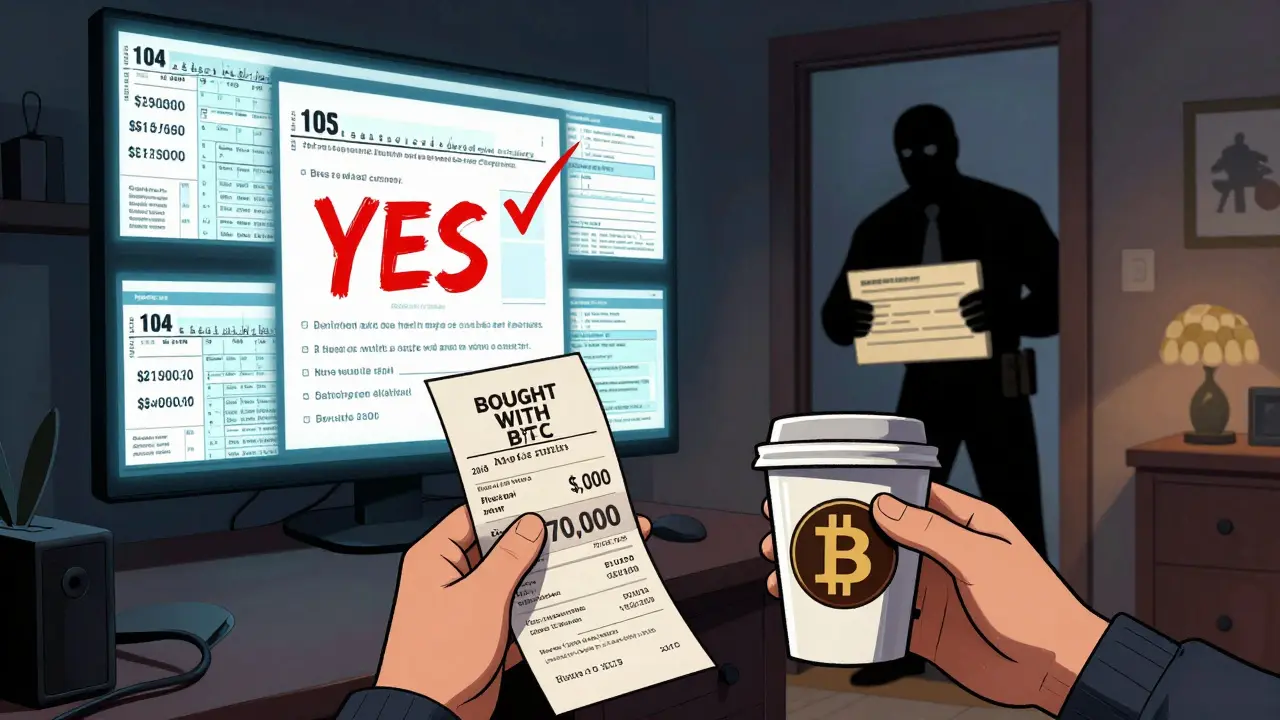
You might hear about bills like the GENIUS Act (2025) or the CLARITY Bill. These aim to clarify regulation, define securities, and set rules for exchanges. But none of them change the IRS’s core position: Bitcoin is property. Even if the SEC says a token is a security, the IRS doesn’t follow suit. Tax treatment and regulatory classification are two different systems. You can be regulated by the SEC and taxed by the IRS - and they don’t always agree. The IRS has doubled down. It added a question to Form 1040 in 2020: “At any time during 2024, did you receive, sell, send, exchange, or otherwise acquire any financial interest in any virtual currency?” Answer “yes” incorrectly? You’re risking an audit. Answer “no” when you should’ve said “yes”? That’s tax fraud.What Happens If You Don’t Report?
The IRS isn’t guessing anymore. It’s matching data. Exchanges like Coinbase, Kraken, and Binance now send 1099 forms to the IRS. The agency has cross-referenced millions of transactions. Audits are rising. Penalties range from 20% to 75% of the underpaid tax - plus interest. In extreme cases, failure to report can lead to criminal charges. The message is clear: if you own Bitcoin, you’re not exempt from taxes. You’re just required to do the math.Final Takeaway
Bitcoin as property isn’t a loophole. It’s a framework. It’s complex. It’s inconvenient. But it’s the law - and it’s not going away. The key to staying compliant? Track every transaction. Know your basis. Understand how your usage affects your tax rate. And if you’re unsure - get help from a tax pro who’s worked with crypto before. Don’t assume the IRS will forgive you. They won’t. But if you’re organized, you won’t need forgiveness. You’ll just pay what you owe - and nothing more.Do I have to pay taxes on Bitcoin if I never sell it?
No, you don’t owe tax just for holding Bitcoin. Taxes only apply when you dispose of it - meaning you sell it, trade it for another crypto, or use it to buy something. Holding alone is tax-free. But if you bought it for $10,000 and it’s now worth $50,000, you still owe tax when you eventually sell or spend it.
Can I use FIFO if I don’t track specific purchases?
Yes. If you don’t keep detailed records of which Bitcoin units you bought when, the IRS will assume you used FIFO - first-in, first-out. That means your oldest purchases are treated as the first ones sold. This can lead to higher taxes if early purchases were made at much lower prices. Specific identification is better for tax optimization, but it requires full documentation.
Is receiving Bitcoin as payment for work taxable?
Yes. If you’re paid in Bitcoin for services - whether as an employee or freelancer - the value of the Bitcoin at the time you received it counts as ordinary income. You report it on your W-2 or Schedule C. Later, if you sell that Bitcoin for more, you’ll pay capital gains tax on the increase.
Do I need to report Bitcoin transactions under $600?
Yes. The $600 reporting threshold applies to exchanges sending 1099 forms to the IRS - not to your personal tax obligation. You must report every single transaction, no matter how small. Even spending $10 in Bitcoin to buy lunch requires you to calculate and report any gain from the original purchase price.
What if I lost my transaction records?
If you can’t prove your cost basis, the IRS may assume it’s $0. That means you’ll owe tax on the full sale amount - even if you bought it for $5,000 and sold it for $50,000. You’ll owe tax on $50,000 as if it were all profit. Try to reconstruct records using exchange statements, bank transfers, or wallet history. If all else fails, consult a tax professional - but expect higher tax liability.
Alyssa Herndon
March 1, 2026 AT 04:53Ifeanyi Uche
March 2, 2026 AT 08:53Jeff French
March 3, 2026 AT 17:17Elana Vorspan
March 5, 2026 AT 04:56Richard Cooper
March 5, 2026 AT 12:50Dee Resin
March 5, 2026 AT 22:09Tanvi Atal
March 7, 2026 AT 04:55Sony Sebastian
March 7, 2026 AT 11:06Megan Lavery
March 7, 2026 AT 22:16Mae Young
March 8, 2026 AT 02:38Trenton White
March 9, 2026 AT 03:21Cory Derby
March 9, 2026 AT 15:01Andrew Hadder
March 11, 2026 AT 12:09Derek Sasser
March 12, 2026 AT 19:36Dana Sikand
March 13, 2026 AT 16:29maya keta
March 14, 2026 AT 20:05Curtis Dunnett-Jones
March 16, 2026 AT 16:32Lilly Markou
March 18, 2026 AT 13:39McKenna Becker
March 19, 2026 AT 17:50precious Ncube
March 19, 2026 AT 18:49Phillip Marson
March 20, 2026 AT 23:27Tracy Whetsel
March 21, 2026 AT 05:04Danny Kim
March 21, 2026 AT 07:37Cathy Sunshine
March 22, 2026 AT 19:23