
Remember the early days of Cosmos DeFi? You probably remember Gravity DEX, which promised to bring order book trading to the blockchain but struggled with high fees and inflation concerns. Well, that project didn't just die. It evolved into what we now know as Crescent Network, a decentralized finance hub built specifically to fix those early mistakes. But here is the real question you need answered today: Is Crescent Network actually worth your time and capital in 2026, or is it another abandoned experiment from the bear market?
I’ve spent weeks digging through their GitHub commits, analyzing their hybrid architecture, and comparing their liquidity models against giants like Uniswap and other Cosmos-based exchanges. The truth is complicated. Crescent offers some genuinely clever technical solutions-like batch execution to stop front-running-but it also carries the baggage of a past failure and a relatively quiet development phase recently. Let’s break down exactly what this platform is, how it works, and whether you should trust your assets to it.
What Exactly Is Crescent Network?
Crescent Network is not your typical Automated Market Maker (AMM) where you just throw tokens into a pool and hope for the best. It positions itself as a comprehensive DeFi Hub within the Cosmos ecosystem. Its main goal is to maximize financial returns while actively managing risk through sophisticated products.
The platform emerged from the ashes of Gravity DEX. Back in July 2021, Gravity DEX launched as a collaboration between B-Harvest and Ignite (formerly Tendermint). It failed to generate expected results because the model required increasing ATOM inflation to fund rewards, which frustrated the community. Instead of shutting down, the team migrated the technology to an independent network: Crescent. This shift allowed them to control their own governance, tokenomics, and infrastructure without relying on the Cosmos Hub’s native token for subsidies.
Think of it this way: Gravity DEX was a prototype that proved the concept but broke under economic pressure. Crescent Network is the production-ready version, rebuilt from the ground up to be economically sustainable.
The Hybrid Engine: AMM Meets Order Book
Most decentralized exchanges force you to choose between two bad options. You either use an AMM (like Uniswap), which suffers from impermanent loss and slippage on large trades, or you try to find a liquidity-heavy order book, which often has thin depth in crypto.
Crescent Network tries to have its cake and eat it too by using a Hybrid AMM/Orderbook model. Here is how that actually helps you:
- Ranged Pools: Unlike standard AMMs where liquidity is spread across all possible prices (which is inefficient), Crescent uses ranged pools. You allocate liquidity within specific price ranges. This increases capital efficiency because your money is working harder only where trading is likely to happen.
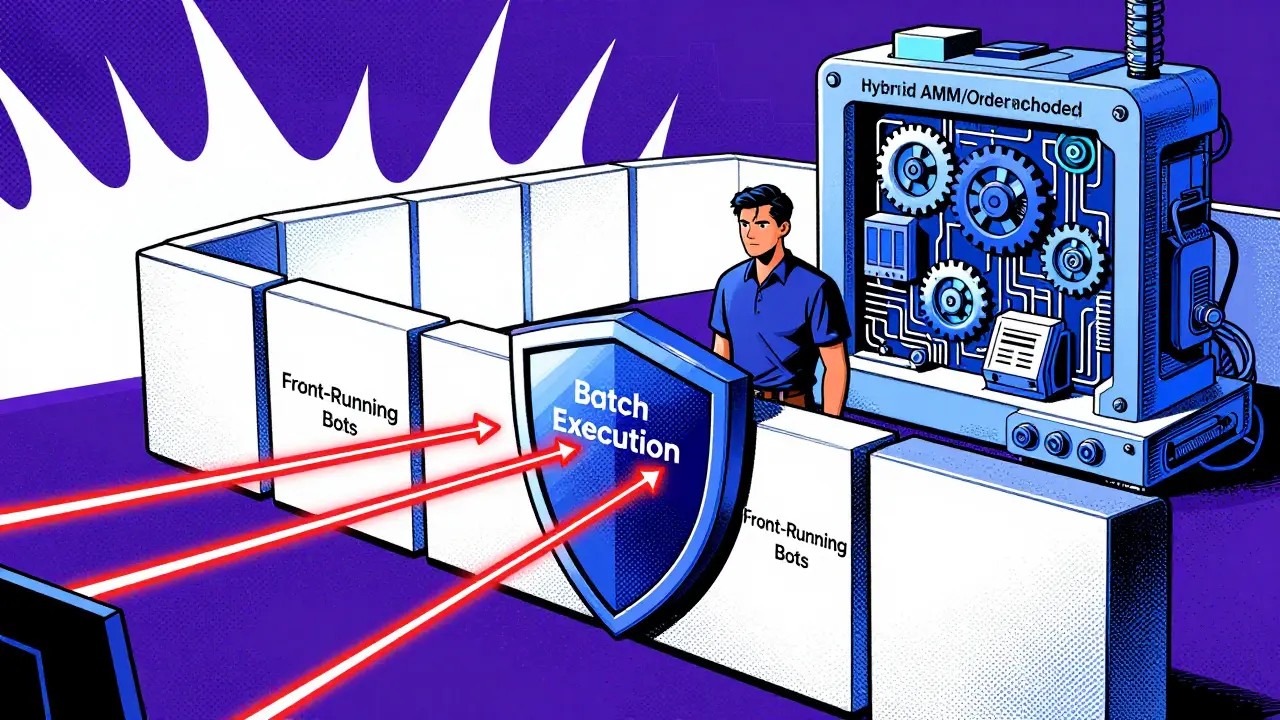
- Batch Execution: This is a big deal for fairness. In many DEXs, bots watch the mempool and front-run your transactions. Crescent accumulates deposits, withdrawals, and orders, then executes them all at the same time. This removes the incentive for validators to engage in Validator Extractable Value (VEV) or front-running.
- Tick System: For users who prefer traditional trading interfaces, Crescent implements a tick system. This standardizes the order book, making it easier for arbitrageurs and market makers to participate, which ultimately means tighter spreads for you.
This architecture prevents the "low-latency competition" that hurts retail traders. You aren’t racing against a bot; you’re entering a fair queue.
Crescent DEX, Boost, and Derivatives
The platform isn’t just one tool; it’s structured around three main operational branches designed to enhance profitability:
- Crescent DEX: The foundational marketplace. It focuses on capital efficiency through the hybrid methods mentioned above. It supports multi-chain asset exchange via InterBlockchain Technology (IBC), meaning you can trade assets from other Cosmos chains directly here.
- Crescent Boost: Designed to optimize yield for liquidity providers. While details are still emerging, the intent is to provide better incentives than the raw swap fees alone.
- Crescent Derivatives: This is the future-facing part of the roadmap. Derivatives allow for hedging and speculation without holding the underlying asset. However, as of mid-2026, full implementation details remain limited in public documentation.
The vision is clear: create a sticky ecosystem where you can swap, lend, and hedge all within one interface. But vision doesn’t pay bills if the code isn’t maintained.
Technical Health Check: Is It Still Alive?
This is where things get tricky. If you look at the Crescent Network GitHub repository, the most recent commit dates back to September 21, 2023. In the fast-moving world of crypto, two years of silence is a long time.
Does this mean the project is dead? Not necessarily. Many mature blockchain projects enter a maintenance mode where critical updates are pushed quietly rather than daily feature drops. The current stable version is v5.0.x, which requires Go version 1.18 or higher for installation from source. Pre-built binaries are available, showing that the core infrastructure is functional.
However, the lack of recent activity raises red flags for new investors. Are there security patches pending? Is the team still active? Without transparent communication, it’s hard to say. Compare this to active competitors like Osmosis, which sees constant updates and community engagement. Crescent feels like a ghost town compared to the bustling markets of its peers.
The CRE Token: Utility vs. Speculation
Every DeFi protocol needs a token. Crescent uses CRE. Currently, CRE falls under the Yield Farming category on trackers like CoinGecko and LiveCoinWatch.
Here is the reality about CRE right now:
- Limited Data: Specific pricing, market capitalization, and trading volume metrics are not comprehensively available in major data sources. This suggests low liquidity or low interest from traders.
- Governance: Like most Cosmos chains, CRE holders likely have voting power over proposals, such as adjusting the tick system size for the order book.
- Incentives: The token is used to incentivize liquidity providers. But without robust trading volume, these incentives may not be sustainable long-term.
If you are looking to buy CRE for speculative gains, proceed with extreme caution. The lack of visible market depth means you could struggle to exit a position without significant slippage.
| Feature | Crescent Network | Osmosis (Cosmos) | Uniswap (Ethereum) |
|---|---|---|---|
| Trading Model | Hybrid AMM + Order Book | Concentrated Liquidity AMM | Standard & Concentrated AMM |
| Front-Running Protection | High (Batch Execution) | Medium (MEV-Share) | Low (Public Mempool) |
| Development Activity | Low (Last commit Sep 2023) | Very High | Very High |
| Ecosystem Focus | Cosmos IBC | Cosmos IBC | Ethereum L2s |
| User Interface | Web & Mobile (Announced) | Web & Mobile | Web & Mobile |

Security and Risks: What Could Go Wrong?
Security is paramount in DeFi. Crescent Network prioritizes security when handling bridged assets, which is smart since bridges are the #1 target for hackers. However, the "no trading fees" policy until a justified cause is presented is unusual. It suggests the team is trying to attract volume by being free, but it also raises questions about sustainability. How do they pay for validator nodes? How do they fund development?
The biggest risk isn’t a hack-it’s irrelevance. With the Cosmos ecosystem crowded with powerful DEXs like Osmosis and Neutron, Crescent struggles to differentiate itself beyond its hybrid tech. If developers don’t build on it, and users don’t trade on it, the chain becomes a zombie. The lack of recent GitHub activity fuels this fear.
Also, consider the complexity. Hybrid systems are harder to audit than simple AMMs. Have there been recent security audits? The provided data doesn’t mention any recent third-party audit reports. Never deposit funds into a protocol without verifying its latest security status.
Who Should Use Crescent Network?
Let’s be honest about who this is for. If you are a casual trader looking to swap USDC for ATOM quickly, you will probably have a better experience on Osmosis due to higher liquidity and a more polished UI.
Crescent Network might make sense for:
- Arbitrageurs: The batch execution and tick system create opportunities for sophisticated traders who can exploit price differences between Cosmos chains.
- Market Makers: Those who want to provide liquidity in a less competitive environment might find better yields here, assuming the volume exists.
- Cosmos Believers: Users who strongly believe in the original Gravity DEX vision and want to support the evolution of the project.
For everyone else, the risks currently outweigh the benefits. The technology is impressive on paper, but execution matters more. And right now, Crescent looks like it’s sleeping.
Final Verdict: Proceed with Caution
Crescent Network represents a fascinating attempt to solve real problems in DeFi: front-running, capital inefficiency, and poor user experience. Its hybrid AMM/Orderbook model is theoretically superior to many competitors. The batch execution feature is a genuine innovation for fairness.
However, theory doesn’t equal practice. The lack of recent development activity, sparse market data for the CRE token, and strong competition from more active Cosmos DEXs make it a risky play in 2026. Until you see renewed commitment from the team, increased trading volume, and transparent security audits, keep your exposure minimal.
Don’t put your eggs in this basket yet. Watch the GitHub repo. Wait for the mobile app launch. See if the derivatives product delivers value. Only then should you consider allocating significant capital. In crypto, silence is rarely golden-it’s usually a warning sign.
Is Crescent Network safe to use in 2026?
Safety depends on both code security and project viability. While Crescent uses secure batch execution to prevent front-running, the lack of recent GitHub commits since late 2023 raises concerns about ongoing maintenance and security patching. Always verify the latest security audit status before depositing funds.
What is the difference between Crescent Network and Gravity DEX?
Gravity DEX was the original prototype that failed due to economic inefficiencies and reliance on ATOM inflation. Crescent Network is the independent, upgraded successor that migrated away from those constraints, featuring a hybrid AMM/Orderbook model and its own governance structure.
How does Crescent Network prevent front-running?
Crescent uses a batch execution system. Instead of processing transactions individually as they arrive, it accumulates deposits, withdrawals, and orders and executes them simultaneously. This removes the advantage for bots that try to front-run individual transactions in the mempool.
Can I trade Ethereum assets on Crescent Network?
Primarily, Crescent operates within the Cosmos ecosystem using InterBlockchain Technology (IBC). While you can trade bridged assets from other chains, it is not a native Ethereum exchange. You would need to bridge assets into the Cosmos ecosystem first.
Why is there no recent data on the CRE token price?
The lack of comprehensive pricing and volume data suggests low trading activity or liquidity. This is common for niche or dormant DeFi projects. Low liquidity means higher slippage and difficulty exiting positions, so check multiple data aggregators before trading.
Is Crescent Network better than Osmosis?
For most users, Osmosis currently offers better liquidity, a more active developer community, and a wider range of supported assets. Crescent has unique technical features like batch execution, but its lower activity level makes it less practical for everyday trading.