

Trading crypto when your government isn't on board is like walking through a minefield. You might see the potential for massive gains, but one wrong step-like a flagged bank transfer-can lead to frozen accounts or even criminal charges. Whether you're in a country with a total ban or one with confusing "gray area" rules, the only way to survive long-term is a crypto trading compliance strategy. This isn't about finding loopholes to cheat the system; it's about understanding exactly where the legal lines are drawn so you can operate without looking over your shoulder.
| Restriction Level | Core Approach | Key Example | Primary Risk |
|---|---|---|---|
| Total Ban | Prohibits possession and trade | Bangladesh | Criminal prosecution |
| Trading Ban | Prohibits exchanges/mining | China | Account freezes |
| Banking Ban | Blocks fiat on/off-ramps | Nigeria | Fraud via P2P |
| Partial/Selective | Permits investment, not payment | Indonesia | Tax/Licensing errors |
Understanding the Spectrum of Restrictions
Not all "restricted" countries are the same. You need to know if you are dealing with a possession ban or a service ban. In places like Bangladesh, the Bangladesh Bank has made it clear: possessing or trading crypto is a legal no-go, often tied to anti-money laundering laws. If you're there, the risk is maximum.
Then you have the China model. While the government banned exchanges and mining back in 2021 to stop capital flight and protect the environment, they haven't explicitly banned you from just holding coins in a private wallet. This is a critical distinction. One is a crime of ownership; the other is a crime of activity. When you understand this, you can shift your strategy from active trading to long-term holding.
In Nigeria, the struggle is mostly at the bank level. The Central Bank of Nigeria has spent years telling banks not to touch crypto. This doesn't mean crypto is illegal to own, but it makes getting your money in and out of the ecosystem a nightmare, often forcing people into risky peer-to-peer (P2P) trades where scams are rampant.
The Compliance Pathway: Assets vs. Currency
One of the smartest ways to stay compliant is to look at how your country classifies digital assets. If your government hates the idea of a "new currency" replacing their own, you might find success if the asset is treated as a commodity. Indonesia did exactly this. Their regulator, Bappebti, treats cryptocurrencies as commodities rather than currency. This allows people to invest and trade them as assets without violating laws against using crypto as a payment method for coffee or rent.
If you're operating in a gray zone, ask yourself: Am I using this to buy things, or am I holding it as an investment? In many restricted zones, the former is a red flag, while the latter is often tolerated or regulated under different rules.
Leveraging Self-Custody and DeFi
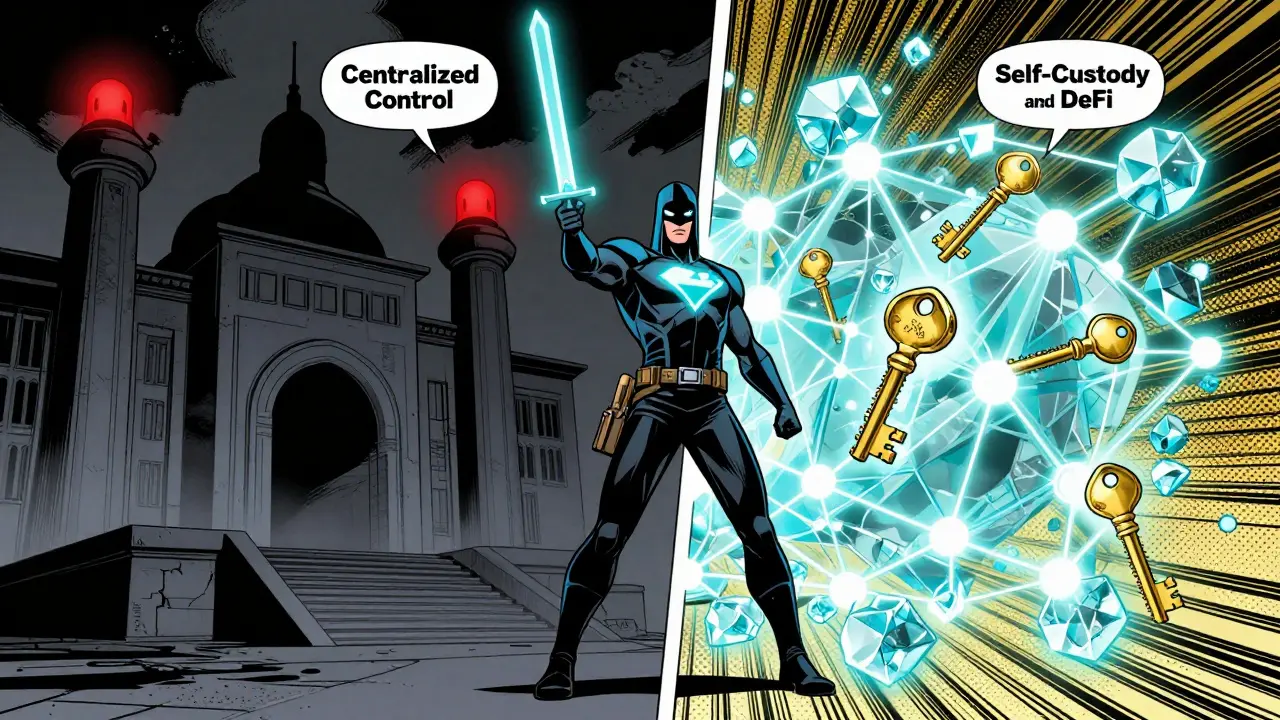
When centralized exchanges (CEX) are banned, the focus shifts to Self-Custody Wallets. These are non-custodial tools where you hold your own private keys. Because there is no company in the middle, there's no one for the government to shut down or subpoena for your user data. This is why adoption remains high in restrictive environments; the technology is designed to bypass the very intermediaries that governments target.
Similarly, DeFi (Decentralized Finance) provides a way to lend, borrow, or swap assets without a centralized entity. Interestingly, data from the Chainalysis 2025 Global Crypto Adoption Index shows that some countries, like Jordan, have massive DeFi value received despite lower retail use of centralized services. This suggests that savvy traders are moving away from the "app store" version of crypto and toward the actual protocols to avoid regulatory friction.
Monitoring the Global Regulatory Shift
The rules are changing fast. By June 2025, the Financial Action Task Force (FATF) reported that 99 jurisdictions were either implementing or updating crypto laws. We are moving away from "ban it all" and toward "license everything."
Look at Hong Kong. They've shifted from a restrictive stance to becoming a hub. Their Stablecoins Ordinance, effective August 2025, requires issuers to have licenses from the Hong Kong Monetary Authority and maintain full reserves. This creates a safe, legal bridge for those who want the benefits of crypto without the legal anxiety.
Similarly, Singapore uses the FIMA Act to give the Monetary Authority of Singapore (MAS) power to inspect crypto-derivative entities, regardless of whether they have a formal license. This proves that the "compliance-first" approach isn't just for restricted countries-it's the standard for the entire industry now.

Choosing a Legal Safe Haven
If the restrictions in your home country are too stifling, some traders look toward geographic arbitrage. This means moving your legal residence or business entity to a crypto-friendly jurisdiction. But don't just pick a place on a map; look at the specific laws.
- Bermuda: Great for businesses thanks to the Digital Asset Business Act and favorable tax policies.
- Australia: Offers a regulated sandbox via the Australian Securities and Investments Commission, making it a great spot for testing new products.
- Panama: A top choice for those worried about taxes, as they generally don't impose capital gains tax on crypto transactions.
- Brazil: A balanced model where assets are classified as securities, ensuring consumer protection while leaving self-custody alone.
Practical Steps for a Compliance-First Strategy
How do you actually implement this? First, perform a gap analysis of your local laws. Do not rely on a blog post from 2021; laws change monthly. Check if your country bans the activity (trading/mining) or the asset (possession). If only the activity is banned, self-custody is your best bet.
Second, separate your fiat and crypto worlds. Using a bank account that is strictly monitored for crypto transfers in a country like Nigeria is a recipe for a frozen account. Look for compliant on-ramps or consider moving your funds to a jurisdiction where you can legally open a corporate account.
Third, prioritize AML (Anti-Money Laundering) and CTF (Counter-Terrorist Financing) standards. Even in restricted countries, regulators are more likely to be lenient if you can prove your funds aren't coming from illicit sources. Keeping meticulous records of every trade is your best defense if you are ever questioned by authorities.
Is it illegal to hold Bitcoin in a country with a trading ban?
It depends on the specific law. In some countries, like China, trading and mining are banned, but holding Bitcoin in a self-custody wallet is generally not prohibited. However, in countries like Bangladesh, the ban may extend to possession, making any amount of crypto illegal. Always check if the ban is on "services" or "assets."
How does the "commodity" classification help traders?
When a government classifies crypto as a commodity (like Indonesia does) rather than a currency, it removes the threat to the national legal tender. This allows traders to legally treat crypto as an investment asset-similar to gold or oil-while still being prohibited from using it as a payment method for goods and services.
What is the risk of using P2P trading in restricted zones?
P2P trading removes the central exchange but increases personal risk. Without a trusted intermediary, you are vulnerable to scams. Additionally, since you are sending fiat directly to another person, banks may flag these "unusual" transfers as suspicious, which can lead to account closures or investigations for money laundering.
Why is DeFi considered a compliance alternative?
DeFi protocols operate via smart contracts on a blockchain rather than through a company. Because there is no "head office" or CEO to regulate, users can often access financial services (like swapping or lending) without needing an account at a restricted centralized exchange.
Which countries are currently the most crypto-friendly for relocation?
Bermuda, Australia, and Panama are currently top choices. Bermuda offers clear regulatory guidance via the Digital Asset Business Act, Australia provides a comprehensive framework with regulatory sandboxes, and Panama is highly attractive due to the lack of capital gains tax on digital assets.