
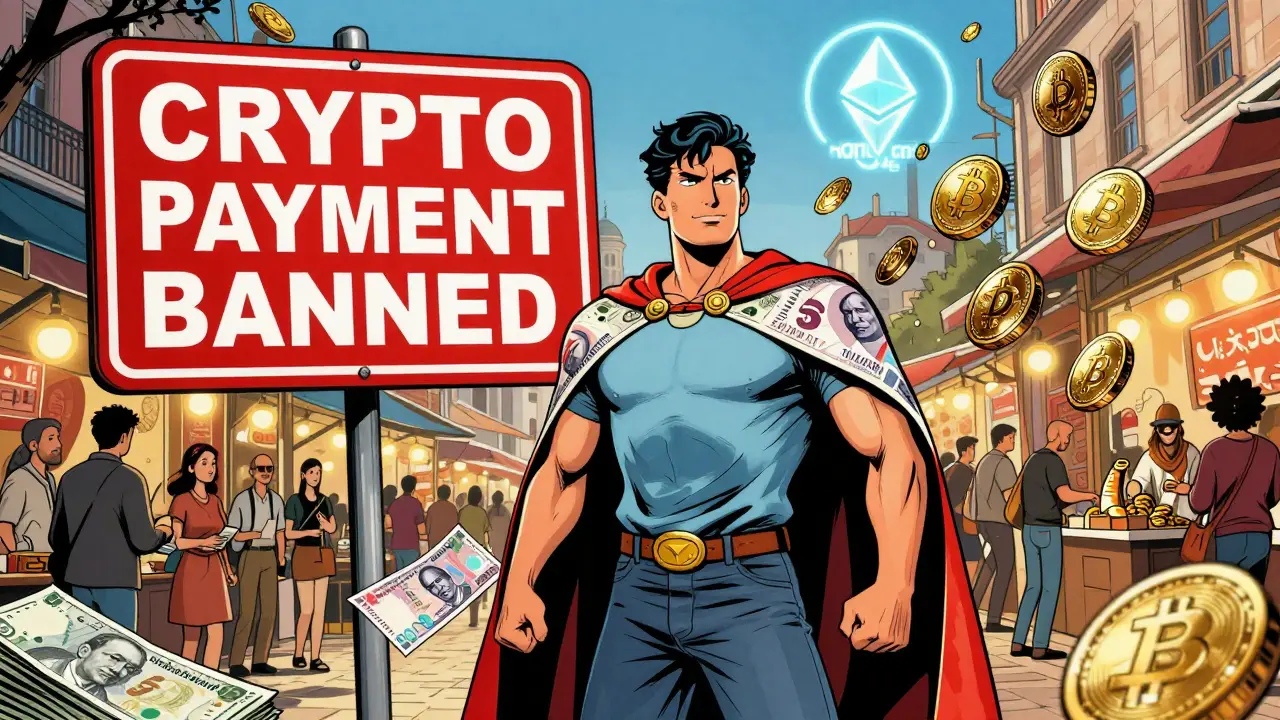
What the Central Bank of Turkey Actually Blocks With Crypto Rules
You can buy Bitcoin in Turkey. You can sell Ethereum. You can hold Dogecoin in a wallet. But if you try to pay for your coffee, rent, or a used car with any of them? That’s illegal. Since April 2021, the Central Bank of the Republic of Turkey (CBRT) is the national monetary authority that controls the Turkish Lira and enforces financial regulations, including strict limits on cryptocurrency use in daily transactions. That rule hasn’t changed in 2026. It’s still the core of Turkey’s crypto policy.
It’s not a ban on crypto. It’s a ban on using it as money. The CBRT doesn’t want digital assets replacing the Turkish Lira in stores, markets, or real estate deals. So while you can trade crypto on local exchanges like Binance TR or Paribu, you can’t use it to buy anything directly. This isn’t about stopping innovation-it’s about keeping control over the currency.
Why Turkey Banned Crypto Payments (But Not Ownership)
Turkey’s inflation hit 85% in 2022. The Turkish Lira lost more than half its value against the dollar in just three years. People panicked. They turned to Bitcoin, Ethereum, and stablecoins like USDT to protect their savings. Crypto became a shield against currency collapse.
The CBRT saw this as a threat. If people stopped using lira for everyday spending, the central bank would lose its ability to manage the economy. Interest rates, money supply, inflation targets-they all depend on people using the official currency. If crypto replaced it, the CBRT would be powerless.
So instead of banning crypto outright, they made a smart move: allow investment, block payments. People can still trade. They can still hold. But they can’t spend it like cash. That keeps the lira alive as the medium of exchange, while letting citizens hedge their wealth.
Who Runs the Show? CMB, MASAK, and TÜBİTAK
The CBRT doesn’t act alone. Crypto regulation in Turkey is split between three agencies:
- Capital Markets Board (CMB) is the main regulator for crypto exchanges, custodians, and trading platforms in Turkey, responsible for licensing and compliance. They set the rules for who can operate.
- Financial Crimes Investigation Board (MASAK) is Turkey’s financial intelligence unit that fights money laundering and tracks suspicious crypto transactions. They’re the ones who fined Binance TR $750,000 in 2023 for weak KYC checks.
- TÜBİTAK is the national science council that sets technical standards for crypto platforms, including security protocols and data storage. They make sure exchanges aren’t hacked or manipulated.
These three work together. If a crypto exchange doesn’t verify users properly, MASAK steps in. If it doesn’t store data securely, TÜBİTAK flags it. If it’s operating without a license? CMB shuts it down.
What Crypto Exchanges Must Do to Stay Legal
Since March 2025, every crypto platform serving Turkish users needs a license from the CMB. It’s not easy. Here’s what they must meet:
- Be a registered joint-stock company with shares issued in cash, not anonymous.
- Hold at least 150 million Turkish Lira ($4.1 million) in capital if they’re an exchange.
- Hold 500 million Turkish Lira ($13.7 million) if they store customer assets (custodians).
- Verify every user’s identity using government ID, with no exceptions.
- Report any transaction over 15,000 Turkish Lira ($425) to MASAK.
- Keep records of every canceled, failed, or completed trade-even if it didn’t go through.
- Install automated systems that flag suspicious trading patterns.
Foreign exchanges like Binance or Kraken can’t just operate in Turkey. They need a local legal entity, a Turkish bank account, and full compliance with all these rules. Most international platforms avoid it. That’s why Turkish users still rely on Binance TR-a local subsidiary built to meet Turkish law.

Why You Can’t Use Crypto to Buy a House
Real estate is one of the biggest assets in Turkey. People invest in property to protect their wealth. But you can’t pay for an apartment with Bitcoin, even if the seller agrees.
The CBRT’s April 2021 rule explicitly bans crypto payments for real estate, vehicles, electronics, or any goods and services. The only way to use crypto for a big purchase is to sell it first on a licensed exchange, convert it to lira, then pay with bank transfer or cash.
This rule hits hard. Imagine you bought Bitcoin in 2021 when it was at $30,000. Now it’s at $70,000. You want to buy a $50,000 apartment. You can’t just send the BTC. You have to sell it, wait for the lira to land in your account, then pay. That’s two transactions, two fees, two delays-and you lose control over timing.
It’s frustrating. But the CBRT’s logic is clear: if crypto became a payment method for real estate, it would destabilize the housing market and make it harder to track property ownership. The state needs to know who owns what-and in what currency.
What You Can Still Do With Crypto in Turkey
Despite the restrictions, Turkey remains one of the top crypto markets in the world. Here’s what’s still legal:
- Buying and selling crypto on licensed exchanges.
- Holding crypto in personal wallets (hardware, software, paper).
- Using crypto as an investment or savings tool.
- Participating in initial coin offerings (ICOs) if the project is reviewed by the exchange.
- Trading crypto derivatives? No. That’s banned.
- Using crypto for international remittances? Technically allowed, but banks monitor large transfers over $50,000.
Many Turks treat crypto like gold. They buy it when inflation spikes, hold it for months, then sell it when the lira weakens further. It’s not a payment system-it’s a store of value. And that’s exactly what the CBRT allows.
The Digital Lira Is Coming-And It’s Not Crypto
The CBRT isn’t fighting blockchain. It’s building its own version. The Digital Lira is a central bank digital currency (CBDC) being developed by the Central Bank of Turkey to digitize the Turkish Lira, offering faster payments and better monetary control without relying on private crypto assets. Unlike Bitcoin or Ethereum, it’s not decentralized. It’s controlled by the state.
The Digital Lira will work like digital cash. You’ll be able to send it to anyone with a phone, even without a bank account. It’ll be faster than bank transfers, cheaper than cards, and fully traceable.
It’s not meant to compete with crypto. It’s meant to replace the need for it in payments. If people can use a safe, fast, government-backed digital lira, they’ll have less reason to turn to Bitcoin for daily spending.
Testing started in 2024. Full rollout is expected by late 2026. When it arrives, it could change how Turks use money forever.

What Happens If You Break the Rules?
Violating crypto payment rules doesn’t land you in jail. But it can cost you.
In 2023, Binance TR was fined 8 million Turkish Lira ($750,000) for failing to verify users and report suspicious activity. MASAK doesn’t mess around. They’ve started freezing bank accounts linked to unlicensed crypto platforms. They’re also going after rented wallets-accounts used by multiple people to hide identities.
If you’re a regular user and you pay for groceries with Bitcoin? You won’t get arrested. But if you run a business that accepts crypto, you could be shut down. The CBRT and CMB are focused on businesses, not individuals. Still, if you’re caught repeatedly using crypto to pay for services, you might get flagged by MASAK.
And if you’re a crypto exchange operator without a license? You’re out of business. The CMB has already shut down over 12 unlicensed platforms since 2024.
How Turkish Users Still Get Around the Rules
People find ways. Some use peer-to-peer (P2P) platforms to buy crypto with lira, then send it abroad to use elsewhere. Others use foreign exchanges with VPNs to bypass local restrictions.
Some businesses quietly accept crypto, then convert it to lira the next day. They don’t advertise it. They just do it. The CBRT can’t monitor every transaction.
But these workarounds are risky. P2P trades have no buyer protection. Foreign exchanges don’t report to MASAK. If you get caught, your account could be frozen. And if you’re a business owner? You’re playing with fire.
The safest path? Stick to licensed exchanges. Convert to lira. Pay with lira. It’s slower. It’s more steps. But it’s legal.
What’s Next for Crypto in Turkey?
Expect more enforcement. MASAK is getting new powers to freeze crypto wallets directly. The CMB is preparing rules for tokenizing real estate and gold-turning physical assets into digital tokens on blockchain. That’s not crypto trading. It’s asset digitization. And it’s legal.
More institutions are getting involved. Banks are testing blockchain for cross-border payments. Insurance companies are exploring smart contracts. The government isn’t against tech. It just doesn’t want private digital currencies replacing the lira.
By 2027, Turkey could be one of the first countries to fully integrate tokenized real assets into its financial system. But crypto as money? That door is locked.
Can I still buy Bitcoin in Turkey in 2026?
Yes. You can legally buy, sell, and hold Bitcoin and other cryptocurrencies on licensed exchanges like Binance TR or Paribu. The Central Bank of Turkey only bans using crypto to pay for goods and services-not owning or trading it.
Can I pay for my rent with Ethereum?
No. Since April 2021, it’s illegal to use any cryptocurrency to pay for rent, utilities, groceries, or any other goods and services in Turkey. You must convert crypto to Turkish Lira first through a licensed exchange.
Is Binance allowed in Turkey?
Only Binance TR, the local subsidiary, is licensed. The global Binance platform is blocked in Turkey. Binance TR follows all local rules: KYC, capital requirements, transaction reporting, and anti-money laundering checks.
What happens if I use crypto to buy a car?
If you’re an individual, you won’t face criminal charges. But if you’re a business accepting crypto for car sales, you risk being fined or shut down by the Capital Markets Board. The CBRT targets businesses, not individuals-but enforcement is increasing.
Is the Digital Lira the same as Bitcoin?
No. The Digital Lira is a central bank digital currency (CBDC) issued and controlled by the Central Bank of Turkey. It’s not decentralized. It’s not mined. It’s just the Turkish Lira in digital form. Bitcoin is private, global, and uncontrolled. The Digital Lira is meant to replace the need for crypto in payments.
Can I use crypto to send money to family abroad?
Technically yes, but it’s risky. Banks monitor international transfers over $50,000. If you send crypto abroad and convert it to foreign currency, it could trigger reporting requirements. Using licensed exchanges and declaring the transfer is safer than using unregulated P2P platforms.
Are crypto profits taxed in Turkey?
As of 2026, there is no specific capital gains tax on crypto profits in Turkey. However, the government is reviewing tax policy, and changes could come in 2027. Always keep records of your trades in case rules change.
mahikshith reddy
February 4, 2026 AT 05:59Deeksha Sharma
February 5, 2026 AT 14:19Shruti Sharma
February 7, 2026 AT 10:49Nathaniel Okubule
February 9, 2026 AT 06:58sabeer ibrahim
February 10, 2026 AT 22:54Paul Gariepy
February 12, 2026 AT 18:33Michael Sullivan
February 14, 2026 AT 04:39orville matibag
February 14, 2026 AT 06:25Robin Ødis
February 15, 2026 AT 23:06David Bain
February 16, 2026 AT 04:43Josh Flohre
February 17, 2026 AT 01:21Jesse Pasichnyk
February 18, 2026 AT 00:22Sharon Lois
February 19, 2026 AT 06:25Reda Adaou
February 19, 2026 AT 16:28Matthew Ryan
February 21, 2026 AT 10:24Molly Andrejko
February 22, 2026 AT 09:16Kyle Pearce-O'Brien
February 24, 2026 AT 02:32Jordan Axtell
February 24, 2026 AT 03:20Alisha Arora
February 25, 2026 AT 06:26Udit Pandey
February 25, 2026 AT 15:21