
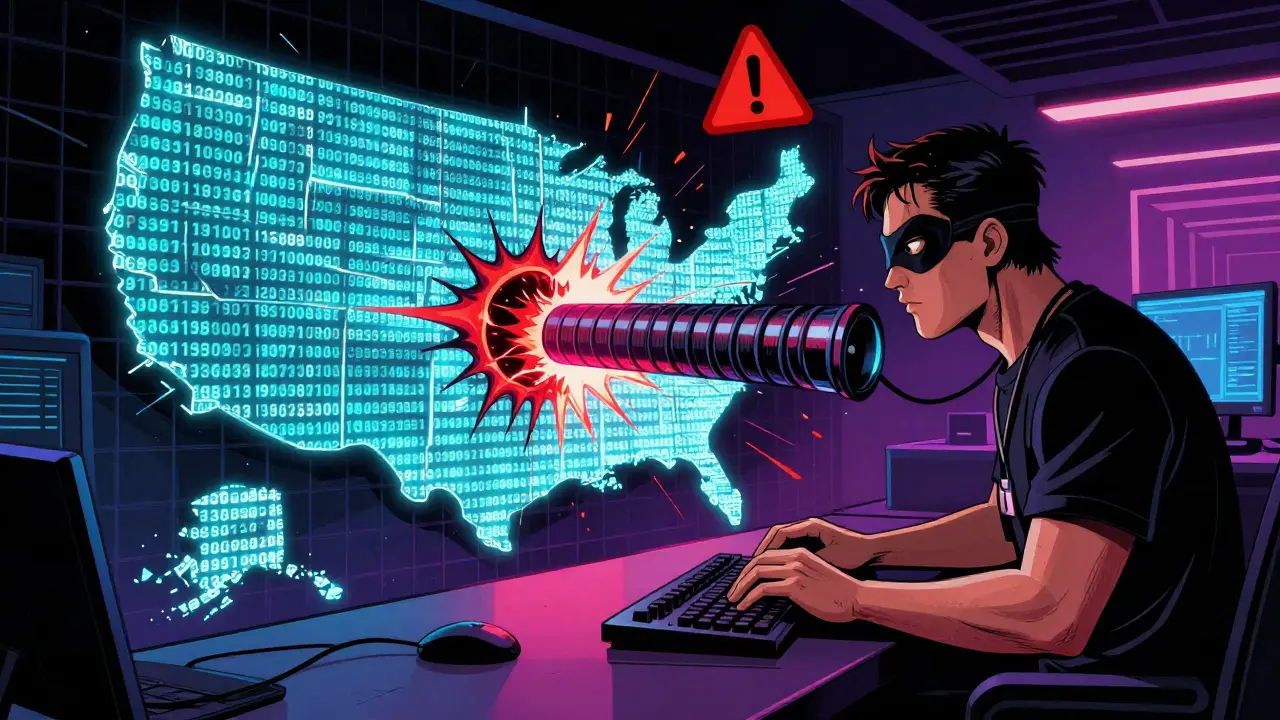
If you're a crypto trader trying to access Bybit from the United States, you've probably run into a wall. No matter how many times you refresh the page, you get blocked. It's not a glitch-it's geofencing. Bybit doesn't let users from certain countries, especially the U.S., connect directly. This isn't about technical issues. It's about legal risk. And while many traders find ways around it, the system is far from foolproof.
How Bybit Blocks Users by Location
Bybit uses IP address geolocation to determine where you're connecting from. When you try to sign up or log in, the platform checks your public IP against a database of known locations. If your IP shows up as coming from the U.S., Canada, or a handful of other restricted regions, access is denied before you even see the login screen. This is geofencing in its simplest form: a digital fence around a service.
It's not just about signup. Bybit also monitors your IP during active sessions. If you're logged in and suddenly switch from a Singapore IP to a New York IP, the system may log you out or flag your account. This is meant to stop people from using VPNs to sneak in after already having an account.
Why Bybit Does This
Bybit doesn't have a U.S. license. Unlike Coinbase or Kraken, which spent years getting approved by U.S. regulators, Bybit chose to stay offshore. That means it can't legally offer derivatives trading to Americans under SEC and CFTC rules. Instead of fighting regulators head-on, Bybit built a wall. It's not perfect, but it's cheaper than hiring lawyers in every state.
This strategy isn't unique. After Binance paid $4.3 billion to settle with U.S. authorities, other global exchanges like Bybit, Bitget, and OKX followed suit. They didn't build U.S. subsidiaries-they just blocked U.S. IPs. It's a common workaround in crypto: if you can't comply, exclude.
How Traders Bypass the Block (And Why It’s Risky)
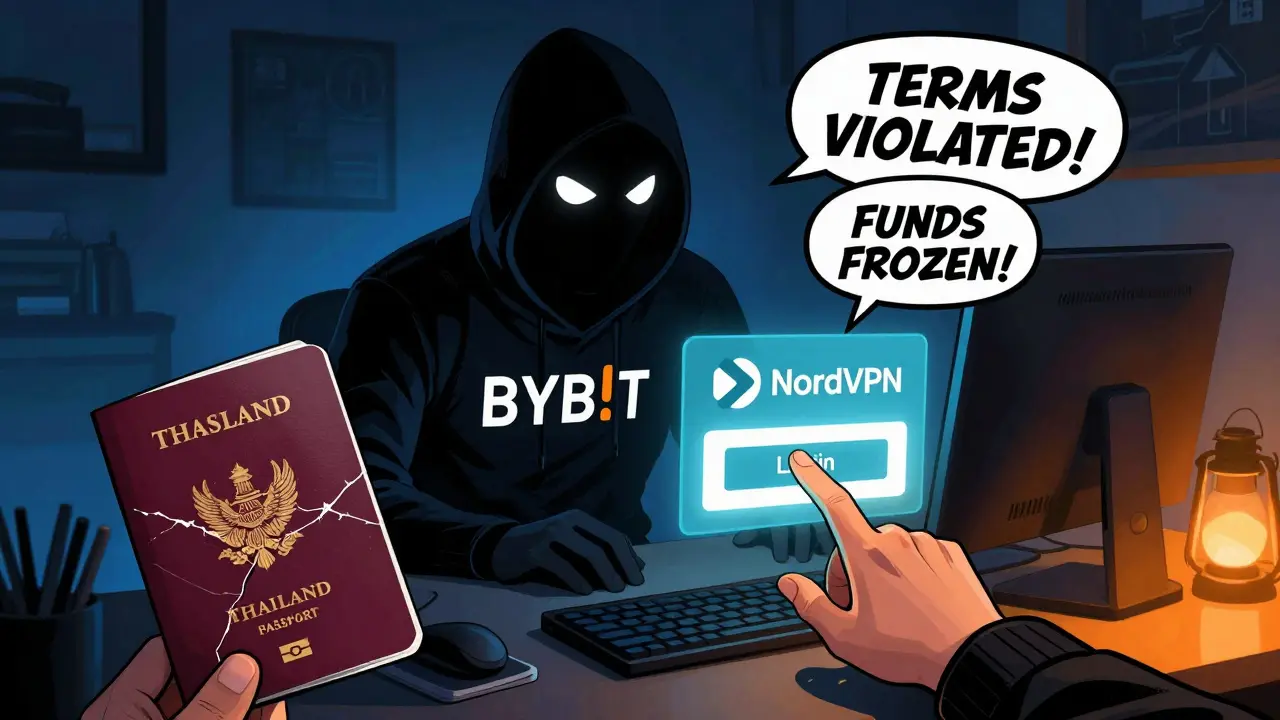
Most traders who want access use a VPN. Connect to a server in Hong Kong, Singapore, or Germany, and suddenly Bybit lets you in. Some even use fake IDs-passport scans from Thailand or Poland-to pass KYC checks. It works. CoinDesk confirmed this in late 2024: users were successfully creating accounts using foreign documents while connecting via standard commercial VPNs like NordVPN or ExpressVPN.
But here’s the catch: Bybit’s terms of service explicitly forbid this. If they catch you, they can freeze your funds, close your account, or even report you to authorities. There’s no guarantee you’ll get your money back. And while many users swear they’ve never been caught, others report sudden account freezes with no explanation.
And it’s not just about rules. Using a VPN to access Bybit from the U.S. might violate U.S. law. The CFTC considers offshore derivatives trading by U.S. residents a gray area-but one that regulators are increasingly cracking down on.
Why Bybit’s VPN Detection Is Weak
Here’s the real problem: Bybit doesn’t really detect VPNs. It only checks your IP. That’s like locking your front door but leaving the back window wide open.
Most commercial VPNs use shared IP addresses. Thousands of users might be connected through the same server. Bybit can’t tell if you’re using a VPN unless it has deeper tools-like analyzing your browser fingerprint, checking connection timing, or monitoring device behavior. Bybit doesn’t do any of that.
Compare that to exchanges like Binance or Kraken, which use advanced detection: they look at screen resolution, installed fonts, time zone mismatches, and even how fast you type. If your device behaves like it’s running on a virtual machine or a proxy, they flag it. Bybit doesn’t.
That’s why the CoinDesk investigation found so many U.S. users getting through. They weren’t using fancy tools. Just a $10/month subscription and a passport from a country Bybit allows.
The Bigger Picture: Regulatory Pressure and Security Gaps
Bybit’s geofencing isn’t just about compliance-it’s about survival. In 2023, 17 countries tightened crypto rules, covering 70% of global trading volume. Exchanges that didn’t adapt got fined, shut down, or forced into bankruptcy. Bybit chose the path of least resistance: block, don’t engage.
But there’s a dark side. In early 2024, Bybit suffered a $1.4 billion hack tied to North Korea’s TraderTraitor group. Hackers didn’t break into servers-they manipulated the frontend of Bybit’s SAFE Wallet interface. They tricked CEO Ben Zhou into approving fake transactions by making them look normal. That’s not a firewall failure. It’s a trust failure.
After the hack, Bybit hired Mandiant (Google’s security arm) to rebuild its systems. But even with better security, the geofencing system stayed the same. Why? Because it’s cheap. And because regulators haven’t forced them to upgrade.

What Traders Should Know
If you’re outside the U.S. and using Bybit normally: you’re fine. The system works as intended.
If you’re in the U.S. and using a VPN: you’re playing with fire. Your funds aren’t protected. You’re violating terms of service. And if Bybit ever decides to clean house-which they might after regulatory pressure-you could lose everything.
There’s no such thing as a safe workaround. Even if you’ve used a VPN for years without issue, that doesn’t mean it won’t change tomorrow. One policy update. One automated audit. One internal report. And your account could vanish.
What’s Next for Bybit?
Industry experts believe Bybit will eventually upgrade its detection system. Machine learning models that track user behavior, device fingerprints, and connection anomalies are already being tested by other exchanges. The next version of Bybit’s system might block you not because of your IP-but because your typing speed, mouse movements, or browser plugins match known VPN patterns.
But until then? It’s a game of cat and mouse. Traders keep finding ways in. Bybit keeps turning a blind eye. And regulators? They’re watching.
Can I use Bybit if I live in the United States?
Technically, no. Bybit’s terms of service prohibit access from the U.S. and several other countries. While some users bypass this using VPNs and foreign IDs, doing so violates the platform’s rules. If detected, your account may be frozen or closed, and funds could be seized. There is no legal protection for U.S. users accessing Bybit this way.
Does Bybit detect all VPNs?
No. Bybit relies mainly on IP geolocation, not advanced VPN detection. Most standard VPN services like NordVPN, ExpressVPN, or Surfshark can bypass the block because they use common server IPs that aren’t flagged. Bybit doesn’t analyze browser fingerprints, device behavior, or connection timing-techniques used by more sophisticated exchanges like Kraken or Binance.
What happens if Bybit catches me using a VPN?
If Bybit detects you’re using a VPN to access the platform from a restricted country, they may freeze your account, block withdrawals, or permanently close it. Funds are not guaranteed to be returned. There is no appeals process, and user reports on Reddit and Trustpilot confirm sudden account closures with no explanation. You’re operating outside their legal framework.
Why doesn’t Bybit just get a U.S. license?
Getting a U.S. license would require Bybit to comply with strict regulations from the SEC and CFTC, including capital requirements, reporting rules, and customer fund segregation. For a derivatives-focused exchange like Bybit, that’s expensive and complex. Instead, they chose to maintain a global platform and block U.S. users-a cheaper, faster solution that avoids legal entanglements.
Are there alternatives to Bybit for U.S. traders?
Yes. U.S.-licensed exchanges like Coinbase Pro, Kraken, and Bitstamp offer derivatives trading to American users under full regulatory compliance. These platforms have higher fees and fewer trading pairs than Bybit, but they provide legal access, insurance on funds, and customer support backed by U.S. law. If you want to trade crypto legally in the U.S., these are your only safe options.
christopher luke
February 24, 2026 AT 04:52Dana Sikand
February 24, 2026 AT 05:34bella gonzales
February 25, 2026 AT 20:24Cameron Pearce Macfarlane
February 26, 2026 AT 15:29Elizabeth Smith
February 27, 2026 AT 02:52Jessica Carvajal montiel
February 27, 2026 AT 17:23Daisy Boliaan
February 28, 2026 AT 04:37Paul Reinhart
March 1, 2026 AT 15:42Kristi Emens
March 1, 2026 AT 22:33Samantha Stultz
March 3, 2026 AT 05:39Dianna Bethea
March 4, 2026 AT 14:03Carl Gaard
March 5, 2026 AT 11:45Robert Kromberg
March 6, 2026 AT 02:33Sean Logue
March 7, 2026 AT 19:58Nicki Casey
March 8, 2026 AT 12:39