
Privacy Comparison Calculator
How Much Information Do You Share?
Compare traditional identity verification with blockchain-based verification for specific scenarios. See how blockchain identity protects your privacy by only sharing necessary information.
Results
Traditional System
Select a scenario to see comparison
Blockchain System
Select a scenario to see comparison
Privacy Benefits
Select a scenario to see comparison
Imagine logging into your bank, signing a lease, or buying alcohol online - without ever showing your driver’s license, passport, or birth certificate. No uploading documents. No waiting days for verification. Just a quick scan, a tap, and you’re in. That’s not science fiction. It’s what blockchain identity authentication makes possible today.
Right now, most of us live with broken digital identities. Every website, app, or service asks for the same personal info: name, address, date of birth, ID number. You upload it. They store it. And if one company gets hacked - like Equifax in 2017 - your data is exposed across dozens of services. You didn’t give them permission to keep it. You didn’t even know they had it. But you’re stuck with the fallout.
Blockchain identity flips that model. Instead of handing your data to companies, you keep it in your own digital wallet. Only what’s needed is shared. And it’s all verified using math, not middlemen.
How Blockchain Identity Works (No Tech Jargon)
Think of your identity like a digital passport you carry in your phone. This passport isn’t stored on a server somewhere. It’s encrypted and locked with a private key only you control. When you need to prove you’re over 18, you don’t send your full ID card. You send a signed, cryptographically verified claim: “I am over 18.” The system checks the signature. It sees it’s real. And that’s it. Nothing else is revealed.
This system uses three core pieces:
- Decentralized Identifiers (DIDs) - Unique digital addresses for your identity, not tied to any company or government.
- Verifiable Credentials - Digital versions of your driver’s license, university degree, or bank account, issued by trusted sources (like your government or employer).
- Zero-Knowledge Proofs - A way to prove something is true without showing the actual data. Like proving you know a password without saying the password.
These aren’t theoretical. The W3C made them a global standard in 2022. Microsoft, IBM, and the EU are already using them. And they’re built on public blockchains like Ethereum or purpose-built networks like Hyperledger Indy - not Bitcoin, but similar in how they store data securely across thousands of computers.
Why It’s Faster Than Traditional Systems
Traditional identity checks - like opening a bank account or applying for a loan - can take 24 to 72 hours. Why? Because someone has to manually review your documents, call your employer, verify your address, cross-check databases. It’s slow. Expensive. Error-prone.
With blockchain identity, verification happens in seconds. Consensys found optimized systems verify 98% of requests in under two seconds. Why? Because the data is already verified and stored in a way the system can instantly trust. No human needs to look at it.
Take mortgage applications. J.P. Morgan’s Kinexys team reported that blockchain-based verification cuts the time from days to hours. In Switzerland’s digital ID system for health services, 92% of users said the process was faster and more private than paper-based methods.
And the cost savings? Dock Labs found blockchain reduces verification costs by 65%. That’s not just for big banks - it matters for small businesses, gig workers, even students trying to prove their enrollment.
Security: No More Single Points of Failure
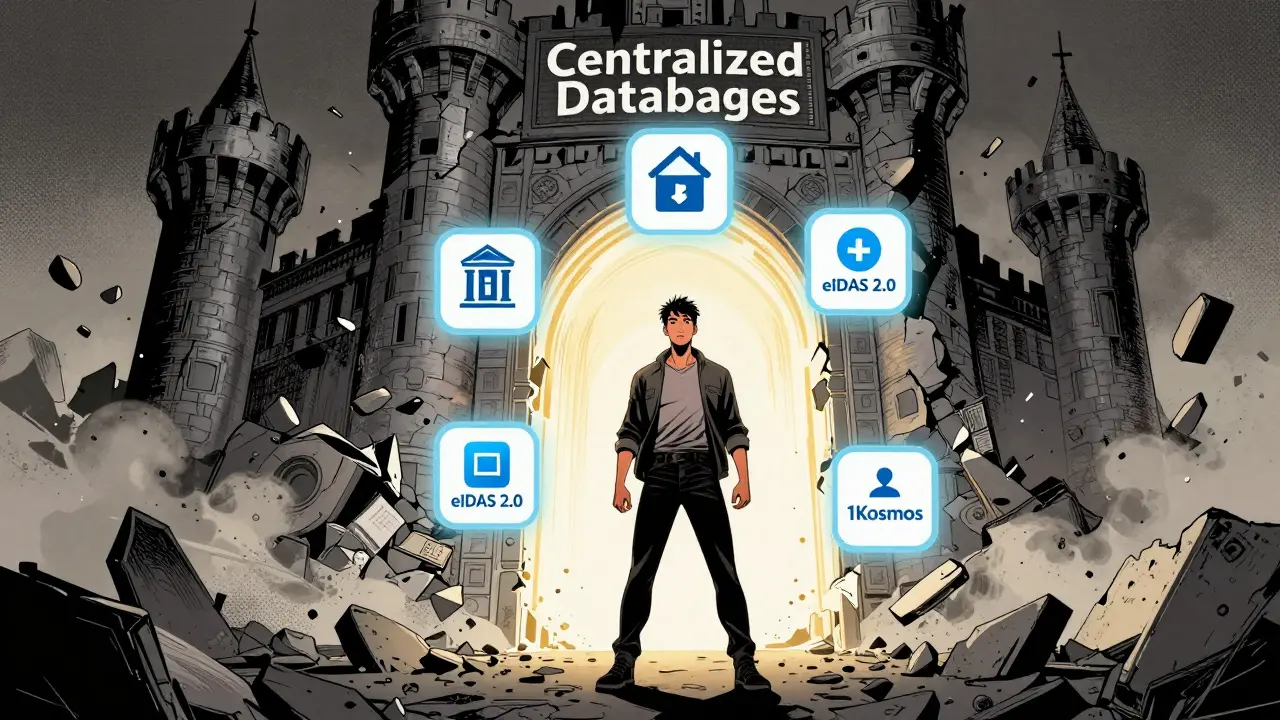
Centralized databases are magnets for hackers. One breach, and millions of records are stolen. In 2023 alone, over 1.2 billion records were exposed globally, according to IBM’s Cost of a Data Breach report.
Blockchain identity has no central database. Your data is stored on your device. The verification happens across a network of computers. Even if one node is compromised, the system keeps running. No single hack can wipe out millions of identities.
Plus, your credentials are cryptographically signed. If someone tries to fake your university degree, the system instantly knows it’s invalid - because the issuer’s digital signature doesn’t match. You can’t alter or copy it. The record is immutable.
You Own Your Identity - Not the Company
This is the biggest shift. Right now, Facebook, Google, Amazon, and your bank control your digital identity. They decide what data they keep, who they share it with, and when they lock you out.
With blockchain, you’re in charge. You decide who gets what. Want to prove your age to a cannabis dispensary? Send a zero-knowledge proof - no name, no address, no ID number. Just “yes, I’m over 21.”
One Reddit user described using it to enter a concert: “It took 15 seconds. No one saw my ID. No one scanned my passport. Just a quick check on my phone.” That’s the power of self-sovereign identity.
And you can use the same identity across services. No more creating 17 different passwords. No more forgetting which email you used for your gym membership. One verified identity. Everywhere.
Where It’s Already Working (Real Examples)
It’s not just theory. It’s live.
- SwissCovid - Launched in 2022, this government-run digital ID lets citizens prove vaccination status without storing personal data on a central server. 50,000 users rated it 92% satisfaction.
- Microsoft Entra Verified ID - Used by universities and employers to issue digital diplomas and employment certificates. Students can share proof of graduation with any employer, anytime.
- EU’s eIDAS 2.0 - Effective 2026, this regulation makes blockchain-based digital IDs legally valid across all 27 EU countries. A citizen in Germany can open a bank account in Portugal using their national digital ID - no paperwork.
- 1Kosmos BlockID - Used by U.S. federal contractors to replace passwords with biometric-based blockchain verification. No more forgotten passwords. No more brute-force attacks.
These aren’t pilot programs. They’re scaling. MarketsandMarkets predicts the blockchain identity market will hit $8.64 billion by 2028 - up from $1.23 billion in 2023. Financial services lead adoption (42%), then healthcare (28%), then government (20%).
The Downsides - And How to Fix Them
It’s not perfect. And pretending it is will get you in trouble.
Problem 1: Losing your key = losing your identity. If you lose your phone and don’t back up your private key, you’re locked out. No “forgot password?” button. This isn’t a bug - it’s by design. But it scares people.
Solution? Multi-factor recovery. Solutions like 1Kosmos and Microsoft let you set up trusted contacts or hardware keys as backups. Think of it like a safety deposit box with two keys - you need both to open it.
Problem 2: Too complicated for non-tech users. A Microsoft case study found non-technical users needed 8-10 hours of training to feel comfortable. That’s a dealbreaker for mass adoption.
Solution? Better UX. The best systems now hide the blockchain entirely. You just tap “Verify with Identity” and approve a prompt. The tech works in the background. The user doesn’t need to know what a DID is.
Problem 3: Not all systems talk to each other. If your university issues credentials on one blockchain and your bank uses another, they might not recognize each other.
Solution? W3C standards. Since 2022, all major platforms follow the same rules for DIDs and verifiable credentials. Interoperability is no longer a dream - it’s built in.
Problem 4: Legal recognition is patchy. In the U.S., 22 states recognize blockchain IDs. The EU does. But many countries don’t. Until laws catch up, some institutions won’t accept them.
That’s changing fast. The EU’s eIDAS 2.0 is a game-changer. In the U.S., federal legislation is expected by 2026. Until then, adoption is strongest where regulation leads - finance, healthcare, and government services.
Who Should Use It - And Who Doesn’t Need It Yet
Blockchain identity isn’t for everyone. But it’s essential for:
- People who travel or work across borders
- Those tired of resetting passwords or uploading IDs
- Businesses handling KYC, onboarding, or compliance
- Anyone concerned about data privacy
If you just log into Netflix or Amazon, you don’t need it. Your current system works fine. But if you’re applying for loans, renting apartments, verifying credentials, or accessing government services - this is the future. And it’s already here.
The Road Ahead
By 2027, Gartner predicts 30% of consumer digital identities will be blockchain-based. That’s up from just 5% in 2023. Why? Because the pieces are falling into place:
- Regulations are catching up (eIDAS 2.0, state laws)
- Technology is mature (DIDs, ZKPs, interoperable standards)
- Users are demanding privacy
- Costs are dropping
The next big leap? AI-powered identity assurance. The Decentralized Identity Foundation announced in April 2024 that adaptive risk scoring - where your identity strength adjusts based on context - is coming. Need to access your bank account? High assurance. Just logging into a forum? Low assurance. All automatic.
And by 2026, quantum-resistant cryptography will be rolled out - protecting identities against future threats we can’t even imagine yet.
This isn’t about replacing passwords. It’s about replacing a broken system. One that treats your identity like a commodity to be sold, stored, and exploited.
Blockchain identity gives it back to you. Secure. Private. Yours.
Is blockchain identity the same as a crypto wallet?
Not exactly. A crypto wallet holds digital currency like Bitcoin or Ethereum. A blockchain identity wallet holds your verified credentials - like your driver’s license, diploma, or work permit. Many identity wallets use the same tech as crypto wallets (like MetaMask), but they’re designed for proving who you are, not sending money.
Can I still be tracked if I use blockchain identity?
You’re far less trackable than with traditional systems. Services can’t see your full history or link your activities across platforms. Each verification is isolated. The only thing they know is what you choose to share - like “over 18” or “employed at Company X.” Your name, address, and other details stay private unless you reveal them.
What happens if the blockchain goes down?
Blockchain networks are designed to be resilient. Even if some nodes go offline, the rest keep running. Identity verification doesn’t require the blockchain to be online all the time - the credentials are stored on your device and verified using cryptographic proofs. The blockchain only stores the public keys and revocation lists, not your personal data. So if the network has a brief outage, your ability to verify identity remains intact.
Is blockchain identity legal?
Yes, in many places. The European Union’s eIDAS 2.0 regulation, effective in 2026, legally recognizes blockchain-based digital identities. In the U.S., 22 states have passed laws accepting them. Many banks, universities, and government agencies already accept them for KYC, onboarding, and access control. As long as the credentials are issued by trusted authorities and follow W3C standards, they hold legal weight.
How do I get started with blockchain identity?
Start with a digital wallet that supports verifiable credentials - like Microsoft’s Authenticator app or a Sovrin-compatible wallet. Then, get a credential from a trusted issuer - your university, employer, or government. Once you have one, you can use it to prove things like your age, education, or employment. Many services now offer a “Verify with Identity” button - just tap it and approve the request.
nicholas forbes
December 7, 2025 AT 08:58This is actually kind of terrifying. Who decides what gets verified? What if the government issues a credential that says you're 'unreliable'? No recourse? No appeal? This feels like digital authoritarianism dressed up as convenience.
Regina Jestrow
December 8, 2025 AT 05:10Okay but imagine never having to email your transcript again. Or sending a scanned ID to some sketchy Airbnb host. I used Microsoft's Verified ID for my university login last week and it felt like magic. No stress. No uploads. Just... done. 🤯
Martin Hansen
December 9, 2025 AT 10:59Of course it works. Only people who actually understand cryptography and digital sovereignty should be allowed to use it. The average person can't even set up a VPN. Let them keep using passwords. This isn't for peasants.
Lore Vanvliet
December 11, 2025 AT 01:07THIS IS THE NEW WORLD ORDER!!! THEY'RE TAKING YOUR IDENTITY AND LOCKING IT IN A BLOCKCHAIN SO THEY CAN CONTROL YOU!!! THEY'LL USE IT TO DENY YOU HEALTHCARE IF YOU VOTED WRONG!!! I SAW A VIDEO ON TRUTHSOCIAL!!! 🚨💥
Scott Sơn
December 11, 2025 AT 23:44Bro. This isn't just tech. This is liberation. Imagine walking into a bar and the bouncer just *knows* you're 21. No ID. No judgment. No awkward fumbling in your wallet. Just pure, unadulterated digital zen. My soul sighed. 🕊️
Frank Cronin
December 13, 2025 AT 05:44Oh wow, another crypto bro thinking he's a civil rights hero. You're not 'owning your identity'-you're just outsourcing your data to a bunch of unregulated devs who think 'decentralized' means 'no accountability'. And you're okay with that? Pathetic.
Stanley Wong
December 13, 2025 AT 18:09I think the real issue here is not whether the tech works but whether society is ready for it. People get attached to their physical documents not because they're secure but because they're tangible. You can hold a birth certificate. You can't hold a private key. And that emotional disconnect is going to slow adoption more than any technical flaw. I've seen grandparents panic over QR codes. This is going to be a generational rift.
Cristal Consulting
December 14, 2025 AT 12:00Hey if you're nervous about losing your key, start with a backup hardware key or a trusted friend holding part of your recovery phrase. It’s not as scary as it sounds. I helped my mom set hers up last weekend. She’s now using it to verify her senior discount at the pharmacy. Small win, big confidence boost. 💪
Tom Van bergen
December 15, 2025 AT 18:23W3C standards my ass. Who even is W3C? Some Silicon Valley cabal that decided what identity means? I don't need math to prove I'm me. I need my face. My voice. My history. Not some encrypted claim from some faceless issuer
Sandra Lee Beagan
December 17, 2025 AT 13:44In Canada, we've been piloting this with provincial health cards and university credentials since 2021. The UX is still clunky, but the privacy benefits? Unmatched. I no longer hand over my SIN number to every landlord. The system just says 'verified'. No details. No risk. It's like a digital handshake. 🤝
Ben VanDyk
December 18, 2025 AT 02:25you forgot to mention the part where you have to pay a fee to get your credential issued. and that most governments still require paper copies anyway. so you're paying twice. for tech that doesn't actually replace anything yet.
Chris Mitchell
December 19, 2025 AT 15:31Identity isn't data. It's trust. And trust isn't built by algorithms. It's built by relationships. If the system lets me prove I'm over 21 without showing my name, fine. But if it makes me forget I'm a person with a history, a family, a name-then we've lost something deeper than privacy. We've lost humanity.
Chris Jenny
December 19, 2025 AT 18:15THEY'RE USING BLOCKCHAIN TO TRACK EVERYTHING YOU DO. EVERY TIME YOU VERIFY, THEY LOG YOUR LOCATION, YOUR DEVICE, YOUR IP. THIS ISN'T PRIVACY-IT'S A SURVEILLANCE NETWORK COVERED IN CRYPTO JARGON. THE FEDS ARE ALREADY IN THE NODES. DON'T BE FOOLED.