
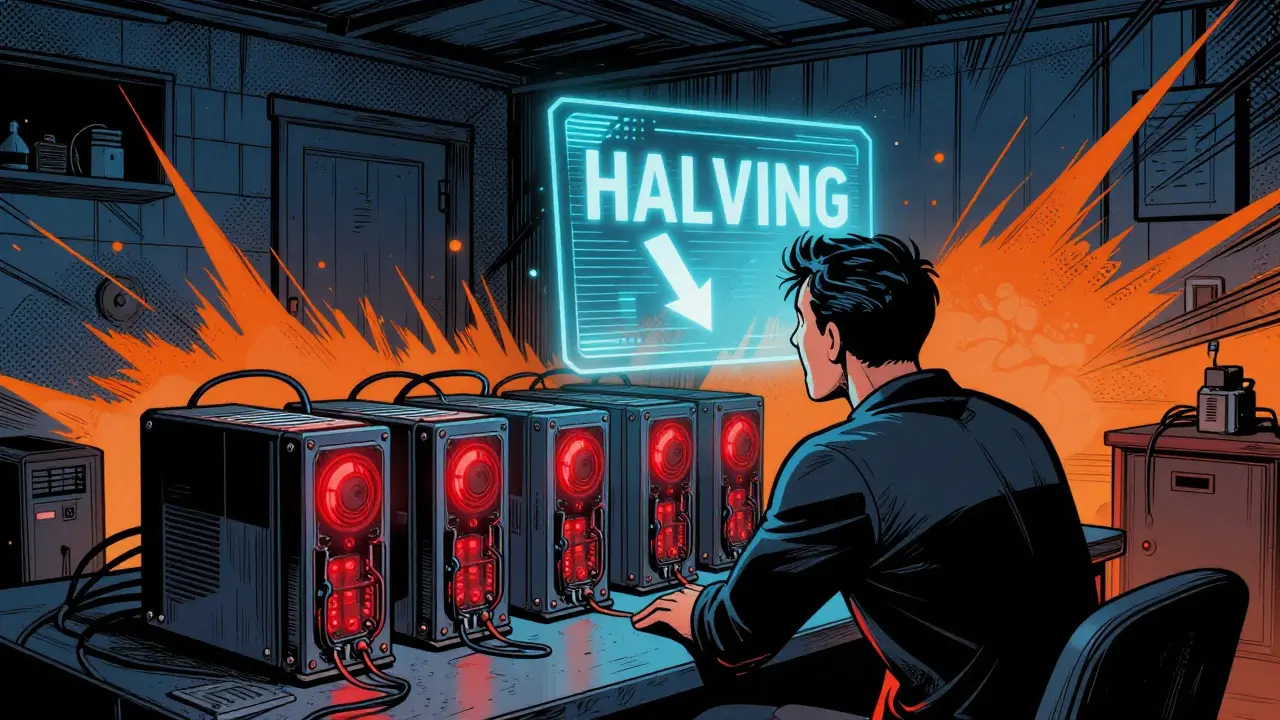
Imagine waking up to find that your monthly paycheck was cut exactly in half, but your rent and electricity bills stayed exactly the same. For thousands of people running Bitcoin mining rigs, this isn't a nightmare-it's a scheduled event called the halving. When the rewards for securing the network drop, not every operation can survive the math. This leads to miner capitulation, a brutal but necessary "cleansing" where inefficient miners are forced to shut down their machines and exit the market.
The Brutal Math of the Halving
To understand why miners quit, you have to look at the core of the network. Bitcoin is designed with a hard cap of 21 million coins. To control the release of these coins, the protocol triggers a halving every 210,000 blocks. In April 2024, for instance, the block reward dropped from 6.25 BTC to 3.125 BTC.
For a mining farm, this is a direct hit to the top line. If you were earning $0.055 per day per terahash, that number suddenly plummeted. Since the cost of electricity doesn't drop just because the Bitcoin protocol changed, many operators find themselves paying more to keep their machines running than they earn in coins. When the cost to mine one Bitcoin exceeds the market price of that Bitcoin, a miner faces a choice: burn through cash reserves or pull the plug.
Who Survives and Who Folds?
Not all mining operations are created equal. The survival of a farm depends on three things: the gear they use, the power they pay for, and the cash they have in the bank. The first casualties are usually those using older ASIC (Application-Specific Integrated Circuit) hardware. If your machine consumes 3000W but produces a low hash rate, you're essentially burning money after a halving.
Energy costs are the real deal-breaker. Miners paying retail electricity rates-often above $0.08 per kWh-almost always capitulate. On the flip side, industrial-scale operations that negotiate long-term contracts below $0.05 per kWh or use "stranded" energy (like excess power from a hydroelectric dam) can ride out the storm. We saw this clearly after the 2024 event; while giants like Marathon Digital and Riot Platforms saw production dips, they had the balance sheets to absorb the blow. Small-scale home miners, however, vanished from the network in droves.
| Miner Profile | Energy Cost (per kWh) | Hardware Status | Likely Outcome |
|---|---|---|---|
| Industrial Giant | Below $0.04 | Latest Generation | Sustainable/Growth |
| Mid-Sized Farm | $0.05 - $0.07 | Mixed Fleet | Tight Margins/Pivot |
| Small/Home Miner | Above $0.08 | Outdated ASICs | Capitulation |
The Ripple Effect on Hash Rate and Difficulty
When a wave of miners shuts down, it triggers a chain reaction. The total Hash Rate-the total computational power securing the network-drops. This is where the Mining Difficulty adjustment comes into play. Every 2,016 blocks, the network checks how fast blocks are being found. If too many miners quit and blocks are taking too long to mine, the difficulty drops.
This adjustment is the network's way of "resetting." As the difficulty lowers, mining becomes slightly easier and more profitable for those who stayed. This often creates a cycle: inefficient miners quit, difficulty drops, and the remaining efficient miners see their profit margins expand. It typically takes three to six months for the network to fully rebalance after a major capitulation event.
Strategies for Surviving the Squeeze
If you're running an operation, you can't just hope for the price of Bitcoin to moon. Survival requires a proactive strategy. First, you need a massive upgrade in efficiency. To maintain pre-halving profits, operations usually need a 15-25% boost in hash rate efficiency. This means swapping old rigs for machines that offer more terahashes per watt of power.
Second, you have to hunt for cheap power. Many firms are now moving toward Renewable Energy sources, like wind or solar, not just for the environment, but because these sources often provide the lowest cost per kilowatt-hour. Some are even partnering with oil companies to use flared gas to power their rigs, turning a waste product into a revenue stream.
Finally, cash is king. A safe operation keeps 6 to 12 months of operating expenses in reserve. This "war chest" allows them to keep the machines humming even if they are technically losing money for a few months, betting that the price of Bitcoin will eventually rise to cover the gap.
The Bigger Picture: Consolidation and Centralization
There is a bittersweet side to miner capitulation. While it strengthens the network's security by ensuring only the most efficient players remain, it also leads to industry consolidation. When a small farm goes bankrupt, a larger company like Bitdeer or TeraWulf often steps in to buy their hardware and energy contracts for pennies on the dollar.
This shifts the landscape from a wide array of independent miners to a few industrial-scale powerhouses. Some argue this risks centralization, but others see it as the natural evolution of the industry. As we look toward the 2028 halving, the competition will only get fiercer. With only about 1.35 million BTC left to be mined, the margin for error is disappearing. Only those with the absolute lowest energy costs and the fastest chips will survive the next round of musical chairs.
What exactly is miner capitulation?
Miner capitulation happens when Bitcoin mining becomes unprofitable due to a halving event or a price drop, forcing miners to shut down their equipment and sell their assets because they can no longer cover their electricity and operational costs.
Does miner capitulation make Bitcoin less secure?
In the very short term, a massive drop in hash rate can look scary, but the network's automatic difficulty adjustment compensates for this. Over time, it actually makes the network more robust by replacing inefficient operators with those who have more sustainable, long-term business models.
How does the halving affect the price of Bitcoin?
While the halving affects miners' income, it reduces the amount of new Bitcoin entering the market. This decrease in supply, combined with steady or increasing demand, has historically put upward pressure on the price, though this isn't a guaranteed law.
Can home miners survive a halving event?
It is extremely difficult for home miners unless they have virtually free electricity. Most home power plans are too expensive to compete with industrial farms that have specialized energy contracts and the latest ASIC hardware.
What is the "Difficulty Adjustment"?
The difficulty adjustment is a protocol feature that happens every 2,016 blocks. It adjusts how hard it is to find a block to ensure that Bitcoin continues to be issued roughly every 10 minutes, regardless of how many miners are active.
Next Steps for Mining Operators
If you are currently managing a mining operation and feeling the squeeze, your priority should be an audit of your energy cost per terahash. If you're paying more than $0.06 per kWh, you are in the danger zone. Look into relocating your hardware to regions with industrial subsidies or explore power purchase agreements (PPAs) with renewable energy providers.
For those with older hardware, calculate the "break-even" Bitcoin price for your specific rigs. If that price is significantly higher than the current market value, it may be more profitable to sell your hardware now while it still has some value rather than waiting for a total collapse in its market price during a mass capitulation event.
Aaron Zeiler
April 26, 2026 AT 22:32honestly the biggest mistake most home miners make is ignoring the heat output too. if you aren't venting that air properly you're just paying to heat your house and killing your gear faster
Carli Bates
April 28, 2026 AT 17:06imagine thinking a digital coin makes you a genius when you're basically just burning the planet for a chance to not be broke lol
Ryan Nakielny
April 29, 2026 AT 12:51oh look another day where we pretend this is all about decentralization while the big firms just buy the crumbs of the dead
Rushell Perry
May 1, 2026 AT 12:31for anyone struggling right now just remember to check your local utility for off-peak rates it can really save your margins
Gabrielle Danis
May 2, 2026 AT 13:35One must consider that the transition to flared gas is not merely a cost-saving measure but a strategic alignment with energy waste mitigation. It provides a hedge against the volatility of the energy market while simultaneously lowering the carbon footprint of the operation.
Jimmy vasquez
May 3, 2026 AT 17:02Great breakdown! If you're looking at hardware, definitely check out the S21 series if you can afford the upgrade, it's way more efficient for the current reward cycle.
Andrew Todd
May 4, 2026 AT 19:39This is why US companies win. We have the scale and the guts to push out the weak ones. Only the strongest survive in a real market.
Sri Astuti
May 6, 2026 AT 06:00It is truly fascinating how we pretend this "cleansing" is a natural market correction when in reality it is just a systematic erasure of the small player to benefit the corporate behemoths who have the liquidity to wait out the dip, and frankly, the obsession with "hash rate" is just a distraction from the fact that the environmental cost is astronomical and completely ignored by the people cheering for this consolidation 🙄
its me
May 6, 2026 AT 16:53I find it interesting that we call this an evolution. It is more of a moral failure to build a system that requires the destruction of the small to sustain the large, but I suppose that is just how the world works now
edie rosa
May 7, 2026 AT 11:40The sheer toxicity of this industry is wild. We are basically rooting for people to go bankrupt so the "difficulty" can go down. It's a race to the bottom of human empathy.
Janis Naglis
May 8, 2026 AT 07:15We should stay positive!!! The network is just optimizing its consensus mechanism via a dynamic equilibrium!!! It's actually a beautiful example of algorithmic self-correction!!!!
Barbara Jones
May 9, 2026 AT 09:01i just think its cool how the code does this automatically. kinda scary but cool... hope the little guys find a way to pivot
Nitin Gupta
May 9, 2026 AT 13:31I agree with the point about renewable energy. In India, we are seeing a lot of interest in integrating solar farms with mining setups to lower that break-even point.
Abhishek Verma
May 9, 2026 AT 14:04Imagine actually thinking your home setup is a business. Cute.
Wayne Gillis
May 10, 2026 AT 15:06Who's selling their rigs? 🚀🔥 I've got some cash and I'm looking to expand my basement setup! DM me! 💰
Rachel S
May 11, 2026 AT 20:51The volatility is simply breathtaking! 😱 It is quite alarming to realize how quickly a business model can evaporate based on a protocol update. One must maintain a rigorous treasury management strategy to avoid total annihilation! 📉
Kathleen Warren
May 11, 2026 AT 22:17It sounds really stressful to be a small miner right now. If anyone is feeling overwhelmed, maybe it's a good time to step back and look at other ways to participate in the ecosystem.
AP Fisher
May 12, 2026 AT 21:54so if the difficulty goes down does that mean the people who didn't quit get more coins
Ipsita Seal
May 13, 2026 AT 05:11too many words