
Imagine trying to trade tokens on the Cardano blockchain back in 2021. You’d likely hit a wall of low liquidity and high slippage. That was the reality before platforms like SundaeSwap took hold. But if you’re looking at the landscape today, specifically regarding AstroSwap, the story is different. Launched officially in October 2023, AstroSwap positioned itself as the “first interstellar DEX” built exclusively for the Cardano ecosystem. But does it still hold up in 2026? Or has it faded into obscurity behind newer competitors?
This review cuts through the hype. We’ll look at how AstroSwap actually works, its fee structure, security model, and whether it’s worth your time compared to established giants like Minswap or WingRiders. If you are holding ADA and want to swap native tokens without leaving the Cardano network, this guide will tell you exactly what to expect.
What Is AstroSwap?
AstroSwap is a decentralized exchange (DEX) platform designed primarily for the Cardano blockchain. Unlike centralized exchanges such as Binance or Coinbase, where a company holds your funds, AstroSwap operates non-custodially. This means you connect your own wallet-like Eternl, Nami, or Lace-and trade directly from your private keys. No one else can freeze your assets.
The platform launched with a bold claim: to solve the liquidity fragmentation that plagued early Cardano DeFi. By leveraging a hybrid architecture, it attempted to combine Cardano’s security with the speed of the Velas blockchain (a high-performance fork of Solana). While Velas promised up to 75,000 transactions per second (TPS), AstroSwap’s primary utility remains swapping native Cardano tokens efficiently.
Key attributes of AstroSwap include:
- Type: Decentralized Exchange (DEX)
- Primary Blockchain: Cardano (ADA)
- Underlying Infrastructure: Velas Chain (for scalability)
- Native Token: ASTRO
- Launch Date: October 2023
- Custody: Non-custodial (User-controlled)
How AstroSwap Works: The User Experience
Getting started with AstroSwap is straightforward if you already have a Cardano-compatible wallet set up. Here is the typical workflow:
- Connect Wallet: Visit the AstroSwap website and click “Connect.” Select your preferred wallet provider (Nami, Eternl, or Lace).
- Select Tokens: Choose the token you want to sell (e.g., ADA) and the token you want to buy (e.g., DJED or SHEN).
- Set Slippage Tolerance: For volatile tokens, you may need to adjust this setting to ensure your transaction goes through despite price changes.
- Confirm Swap: Review the estimated output and confirm the transaction in your wallet. You will pay the standard Cardano network fee plus the AstroSwap trading fee.
The interface is clean and minimalistic, avoiding the clutter often found in older DeFi apps. However, users should note that as of mid-2026, there is no dedicated mobile app. All trading must be done via a web browser, which can be slightly less convenient than using a native iOS or Android application.
Fees and Costs: What Will It Cost You?
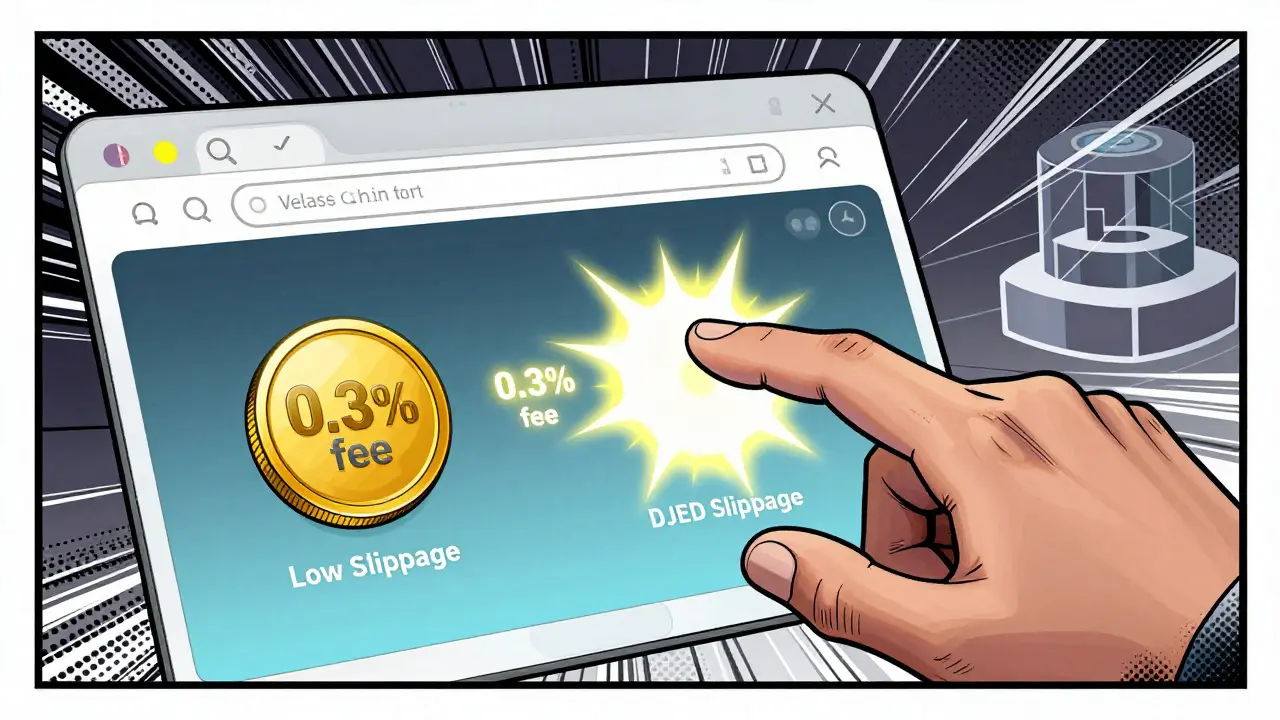
Cost is a major factor when choosing a DEX. AstroSwap charges a flat 0.3% trading fee on all swaps. This is standard across most Automated Market Maker (AMM) protocols, matching the rates seen on Uniswap or PancakeSwap.
However, the total cost isn’t just the trading fee. You also pay the Cardano network transaction fee (often called the “min fee”), which fluctuates based on network congestion but typically ranges between 0.17 ADA and 0.40 ADA for simple swaps. For large-volume traders, these small percentages add up quickly. If you are moving millions of dollars, a centralized exchange with tiered maker-taker fees might be cheaper. For retail traders swapping hundreds or thousands of dollars, the 0.3% fee is reasonable and competitive.
| Platform | Trading Fee | Network Fee (Approx.) | Staking Rewards |
|---|---|---|---|
| AstroSwap | 0.3% | ~0.17 - 0.40 ADA | Yes (ASTRO staking) |
| Minswap | 0.3% | ~0.17 - 0.40 ADA | Yes (MIN staking) |
| SundaeSwap | 0.3% | ~0.17 - 0.40 ADA | Yes (SUNDAE staking) |
| Binance (CEX) | 0.1% (with BNB discount) | N/A (Internal ledger) | Yes (Earn products) |
Security and Safety: Is Your Money Safe?
In decentralized finance, security is paramount. AstroSwap operates as a non-custodial platform, meaning you never deposit funds into their servers. Your assets remain in your wallet until the moment of swap execution. This significantly reduces the risk of exchange hacks draining user balances, as seen in historical CEX failures.
However, smart contract risk always exists. Since AstroSwap uses a hybrid model involving the Velas chain, the security depends on the integrity of both the Cardano smart contracts and the Velas infrastructure. As of 2026, there have been no major reported exploits or hacks specific to AstroSwap’s core protocol. Nevertheless, the development team remains anonymous, operating under the entity name “Astro Swap.” While common in crypto, anonymity can be a red flag for some investors who prefer doxxed teams for accountability.
Best practices for using AstroSwap safely:
- Always verify the URL to avoid phishing sites.
- Use a hardware wallet (like Ledger) connected via Nami or Eternl for larger amounts.
- Revoke token approvals periodically using tools like Revoke.cash (if applicable to the bridge used).
Liquidity and Token Support
Liquidity determines how easily you can buy or sell tokens without affecting the price. When AstroSwap launched in 2023, it faced criticism for lower liquidity compared to incumbents like SundaeSwap, which held roughly 68% of the Cardano DEX market share at the time.
By 2026, the landscape has shifted. AstroSwap supports major Cardano-native tokens including ADA, DJED, SHEN, HOSKY, and various NFT-related tokens. However, for obscure or newly launched micro-cap tokens, you may still encounter higher slippage (price impact) on AstroSwap compared to more established pools on Minswap or WingRiders. If you are trading blue-chip Cardano assets, the experience is smooth. For niche assets, always check the pool depth before executing large trades.
The ASTRO Token: Utility and Staking
The native token of the platform is ASTRO. It serves several purposes within the ecosystem:
- Governance: Holders can vote on future protocol upgrades and parameter changes.
- Staking Rewards: Users can stake ASTRO to earn rewards. At launch, 45% of the 10 billion total supply was allocated for staking incentives, promising high APYs to attract early adopters.
- Fee Discounts: Some DEX models offer reduced fees for token holders; check current AstroSwap docs for active promotions.
The ASTRO token is listed on secondary markets like Gate.io and PancakeSwap. Its value fluctuates based on platform usage and broader crypto market trends. Always conduct your own research (DYOR) before investing in governance tokens, as they carry higher volatility than established coins like Bitcoin or Ethereum.
AstroSwap vs. Competitors: Who Wins?
Choosing a DEX often comes down to personal preference and specific needs. Here is how AstroSwap stacks up against its main rivals in the Cardano space:
- vs. Minswap: Minswap is known for its robust liquidity and multi-pool system. It often has deeper pools for major pairs. If liquidity is your top priority, Minswap might be slightly better. However, AstroSwap offers a cleaner UI for beginners.
- vs. SundaeSwap: SundaeSwap was the first mover and has strong brand recognition. It also features a lottery system similar to AstroSwap’s planned initiatives. SundaeSwap has a larger community, but AstroSwap’s integration with Velas aims for faster finality in certain cross-chain scenarios.
- vs. WingRiders: WingRiders focuses heavily on yield farming and high-APY opportunities. If you are an advanced DeFi user looking to farm yields rather than just swap, WingRides might offer more complex strategies. AstroSwap is simpler and more focused on basic swapping.
Pros and Cons Summary
To help you decide quickly, here is a breakdown of the strengths and weaknesses of using AstroSwap in 2026.
Pros:
- Non-custodial and secure (you control your keys).
- Low barrier to entry; easy to use interface.
- Standard 0.3% fees are competitive.
- Strong focus on Cardano native assets.
- Active staking incentives for ASTRO holders.
Cons:
- No mobile app available (web-only).
- Liquidity for smaller tokens may be lower than Minswap/SundaeSwap.
- Anonymous development team raises some trust concerns.
- Dependency on Velas chain stability adds complexity.
Final Verdict: Should You Use AstroSwap?
If you are a Cardano user looking for a reliable, no-nonsense place to swap native tokens, AstroSwap is a solid choice. It doesn’t try to reinvent the wheel; it provides a stable, secure environment for trading. For daily swaps of ADA to major stablecoins or well-known altcoins, it performs admirably.
However, if you are a high-frequency trader or need deep liquidity for obscure tokens, you might find yourself checking Minswap or WingRiders for better prices. Always compare quotes across multiple DEXs before executing large trades. In the world of DeFi, aggregation tools can save you money by routing your trade through the best available liquidity source.
AstroSwap remains a key player in the Cardano DeFi ecosystem. While it may not dominate market share, it offers a trustworthy, user-friendly experience that aligns with the decentralized ethos of the blockchain.
Is AstroSwap safe to use?
Yes, AstroSwap is generally considered safe because it is non-custodial, meaning you retain control of your private keys. However, as with any DeFi platform, there are risks associated with smart contract vulnerabilities and phishing attacks. Always use official links and consider using a hardware wallet for added security.
Does AstroSwap have a mobile app?
As of 2026, AstroSwap does not have a dedicated mobile application. Users must access the platform via a web browser on their mobile device or desktop. Ensure you are using a compatible wallet like Eternl or Nami which have their own mobile interfaces.
What are the fees on AstroSwap?
AstroSwap charges a standard 0.3% trading fee on all swaps. Additionally, you will pay the standard Cardano network transaction fee, which varies based on network congestion but is typically very low (under $0.10 USD equivalent).
Can I earn rewards by using AstroSwap?
Yes, you can earn rewards by providing liquidity to pools or by staking the native ASTRO token. Staking ASTRO allows you to participate in governance and receive additional token rewards, though APYs fluctuate based on market conditions.
Which wallets work with AstroSwap?
AstroSwap supports popular Cardano wallets including Eternl, Nami, Lace, and Flint. You simply need to install one of these extensions or apps, fund it with ADA, and connect it to the AstroSwap website to begin trading.