

When you hear that $15.8 billion flowed through cryptocurrency wallets tied to sanctioned countries and groups in 2024, it sounds like a massive, unstoppable flood. But the truth is more complicated. That number didn’t come from one clean source - it was pieced together from conflicting reports, different tracking methods, and shifting targets. Some firms said it was $14.8 billion. Others said $2.7 billion. And yet, every single one agreed on one thing: sanctioned entity crypto transactions were still the biggest driver of illicit activity in digital assets last year.
Why Bitcoin Dominated the Sanctioned Flow
Bitcoin wasn’t just the most popular cryptocurrency in 2024 - it was the backbone of sanctions evasion. Of all the transactions linked to OFAC-designated wallets, 68% were in Bitcoin. Why? Because it’s the oldest, most widely accepted, and easiest to move across borders without needing a bank. Unlike newer coins, Bitcoin has decades of transaction history, making it easier for analysts to trace patterns - but also easier for bad actors to hide within normal traffic. Ethereum came in second, accounting for 20% of these transactions. Most of that came from stablecoins like USDT and USDC, which are tied to the U.S. dollar. That’s not a coincidence. When countries like Iran or Russia need to move money quickly and avoid currency swings, they turn to stablecoins. They’re stable, they’re liquid, and they’re accepted on exchanges that don’t ask too many questions.The Real Players Behind the Numbers
It’s easy to think of this as a global problem - but the real action was concentrated. Two exchanges handled over 85% of all crypto inflows to sanctioned entities: Garantex and Nobitex. Both are based in regions with weak oversight, and both became known as go-to platforms for ransomware gangs and state-linked actors. Garantex, in particular, was officially sanctioned by the U.S. Treasury in 2024. Why? Because it wasn’t just processing random transactions. It was moving money from ransomware attacks tied to Conti, Black Basta, LockBit, and Ryuk. One money launderer, Ekaterina Zhdanova, moved over $2 million in Bitcoin through Garantex and turned it into Tether - a clear attempt to launder funds into something that looks like cash. Meanwhile, Iran’s centralized exchanges saw a massive spike in activity. It wasn’t just about trade - it was capital flight. As Western banks cut off access, Iranians turned to crypto to move money out of the country. The same thing happened in Russia, where ransomware payments jumped 22% from 2023 to 2024, hitting $800 million.DeFi: The Wild West of Sanctions Evasion
Decentralized Finance (DeFi) platforms became the new frontier. In 2024, 33% of all illicit crypto funds passed through DeFi protocols. That’s a big jump from previous years. Why? Because unlike traditional exchanges, DeFi doesn’t have a CEO, a support team, or a compliance officer. There’s no single point to shut down. If a wallet gets flagged, users just move to another pool. OFAC flagged 150 DeFi liquidity pools in 2024 - but that’s like trying to block every single alley in a city. The protocols themselves don’t control the money. They’re just code. And that makes enforcement a nightmare. Even if regulators could identify which pools were being used, they can’t freeze them without breaking the entire system. Cross-chain bridges made things even harder. In 19% of all sanctioned transactions, funds were moved between blockchains - Bitcoin to Ethereum, then to Solana, then back again. Each jump added layers of obfuscation. It’s like playing hide-and-seek across multiple cities at once.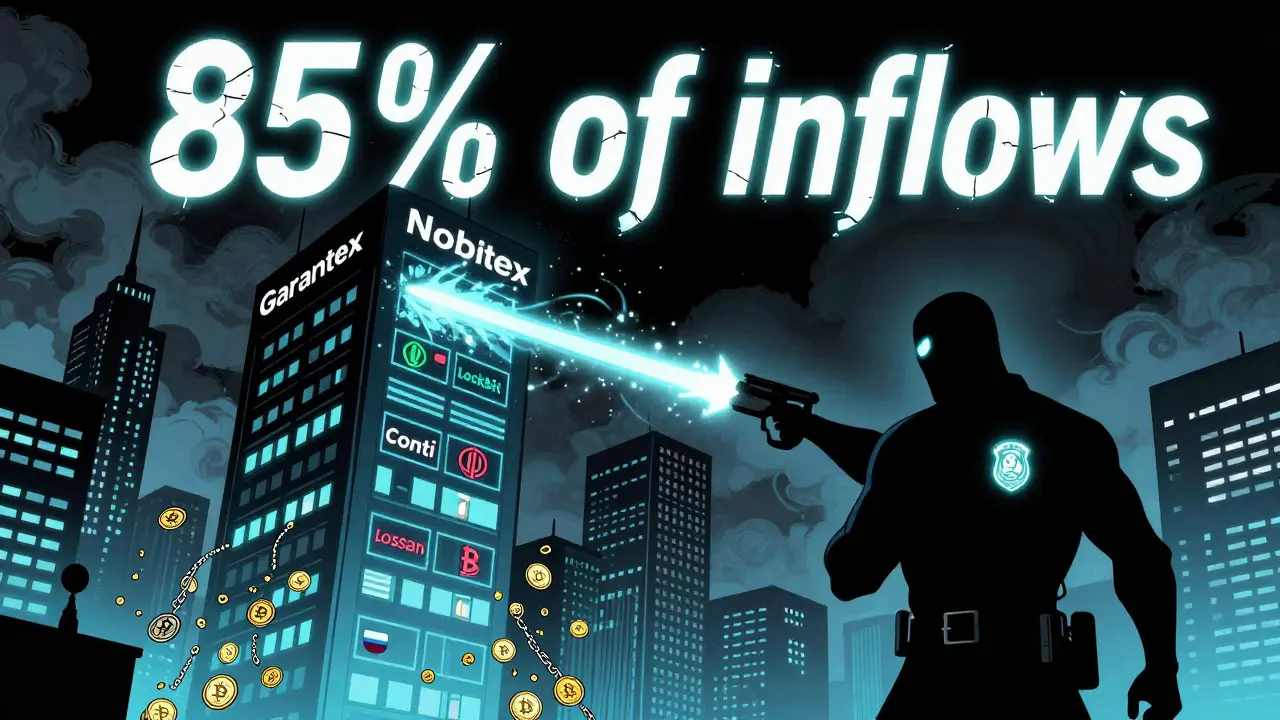
Darknet Markets and the Rise of Ransomware
Darknet marketplaces didn’t disappear - they just got smarter. In 2024, they facilitated $1.1 billion in transactions tied to sanctioned entities. Russia-based markets led the pack. These weren’t just drug dealers. Many were cybercriminal groups that used crypto to demand ransom payments from hospitals, schools, and local governments. The shift was clear: instead of trying to steal money directly, criminals now demanded payment in crypto - and they demanded it from institutions that couldn’t afford to say no. And with ransomware payments up 22%, it’s clear this isn’t slowing down.Why the Numbers Don’t Add Up
Here’s the thing: no one agrees on the exact number. Chainalysis says $15.8 billion. TRM Labs says $14.8 billion. CoinLaw.io says $2.7 billion. Why such a gap? It comes down to how you define “sanctioned.” Some firms only count wallets directly listed by OFAC. Others include wallets that have ever interacted with a sanctioned address - even once. Some track only incoming funds. Others track total movement. Some use AI to predict behavior. Others rely on manual labeling. The truth? All of them are right - and all of them are incomplete. The $15.8 billion figure is a useful snapshot, but it’s not the whole story. It’s like measuring the size of a storm by how much rain fell in one city.
Mohammed Tahseen Shaikh
March 23, 2026 AT 21:24Bitcoin's the OG of dirty money now - no surprise. Everyone's chasing DeFi like it's a magic wand but the truth is, it's just a maze with no exit. Garantex and Nobitex? They're not exchanges, they're toll booths for global crime. And don't even get me started on stablecoins - USDT is the new Swiss bank account with fewer questions.
It's not about the $15.8B. It's about how we're all pretending this is a tech problem when it's really a governance failure.
John Alde
March 25, 2026 AT 12:13It's important to contextualize the data. While $15.8 billion sounds alarming, when you normalize it against the $10.6 trillion in total on-chain volume, illicit activity represents less than 0.15% of all transactions. The narrative of crypto as a lawless frontier is outdated.
Most illicit flows are concentrated in a handful of wallets and protocols. The real innovation isn't in evasion - it's in detection. AI-driven clustering models now identify suspicious behavior with 92% accuracy, even across cross-chain bridges. Regulatory tech is outpacing criminal tech, not the other way around.
manoj kumar
March 26, 2026 AT 12:06So let me get this straight. You're telling me that after all these years of crypto being "decentralized and untraceable," now suddenly we're tracking every single transaction like it's a bank statement? Either the tech is broken or the whole narrative was a lie.
Also, why does every article about crypto crime sound like a PowerPoint from a compliance officer? Just say it: crypto is a laundering tool. No more spin.
Andrew Midwood
March 26, 2026 AT 13:19DeFi is wild but honestly? The real story is the cross-chain bridges. People think Monero or Zcash are the new hotness, but nope. It's all about shuffling between chains. Bitcoin → Ethereum → Solana → Polygon → back to Bitcoin. Each hop adds entropy. Regulators are trying to trace money like it's a GPS ping. But it's more like trying to follow a tornado through three states at once.
Also, Garantex got sanctioned? Bro, they were just the first. The next one’s already live.
Tammy Stevens
March 27, 2026 AT 15:43What really stood out to me is how Iran and Russia used crypto not for trade, but for survival. When your banks are cut off, crypto isn’t a crime-it’s a lifeline. The same people getting labeled as "sanctioned entities" are just trying to feed their families or pay for medicine.
Yes, ransomware gangs abuse it too. But we can’t treat all crypto flows as the same. There’s a difference between a hacker moving $2M and a doctor in Tehran sending $200 to her sister in Turkey. The tools are the same. The intent? Totally different.
Justin Credible
March 29, 2026 AT 09:25lol at the $2.7 billion number. That’s like saying a hurricane only counted rain that fell on one rooftop. All these firms use different filters. Some only track direct OFAC hits. Others include anyone who ever touched a bad wallet once. It’s like arguing whether a fire is big based on how many embers you see from your porch.
Mike Yobra
March 29, 2026 AT 14:55So the real villain here isn’t Bitcoin. It’s the U.S. Treasury. They created this mess by sanctioning everything under the sun until even your grandma’s crypto wallet looks suspicious. Now they’re surprised when people find workarounds?
It’s not crypto that’s broken. It’s the system that thinks it can control money by drawing lines on a map.
Anna Lee
March 29, 2026 AT 16:31Love how everyone’s panicking about $15.8B but ignoring the 99.8% of transactions that are totally clean. Crypto’s growing so fast that even if bad actors doubled their activity, they’d still be a tiny ripple in the ocean.
Let’s celebrate that detection tech is getting better, not just scream about the numbers. Progress is happening!
Neil MacLeod
March 30, 2026 AT 17:35"Sanctioned entity transactions were the biggest driver of illicit activity."
Translation: the only thing keeping this industry from total collapse is that the criminals are still using the same old tools. If they were smart, they’d be using AI-generated wallets, zero-knowledge proofs, and private layer-2 networks. Instead, they’re still shuffling USDT like it’s 2017.
We’re not winning the war. They’re just bad at their job.
Pradip Solanki
April 1, 2026 AT 15:31Everyone’s acting like this is new. Newsflash: this has been going on since 2013. The only difference now is that the media finally noticed. And now we’ve got a whole industry selling "blockchain intelligence" like it’s a miracle cure.
Real talk? If you can’t track it, it doesn’t exist. That’s why CoinLaw.io says $2.7B. They’re the only ones who actually know what they’re counting.
Brad Zenner
April 3, 2026 AT 09:41The most interesting part? The drop in illicit share relative to total volume. That’s the real win. It means legitimate users are outgrowing the criminals. More adoption → more noise → harder to hide.
It’s like trying to steal a dollar from a crowd of 10,000 people. The more people there are, the less likely you’ll get away with it. That’s the quiet revolution here.
Alice Clancy
April 4, 2026 AT 16:58So let me get this straight - Iran and Russia are using crypto to bypass sanctions, and we’re supposed to feel bad? Nah. They’re the ones who started this. If they didn’t break international rules, none of this would be happening.
Also, why is everyone so nice to DeFi? It’s just a hacker playground with fancy names. Shut it down. All of it.
Marie Mapilar
April 5, 2026 AT 16:38I think we’re missing the human side. Behind every wallet is a person. A doctor in Iran. A small business owner in Russia. A parent trying to send money home. Yes, bad actors hide in the noise - but so do millions of ordinary people.
Maybe instead of policing every transaction, we should build better tools for the honest folks. Let them move money freely. The bad guys will still slip through - but we won’t be punishing the whole system for their crimes.
Shelley Dunbrook
April 7, 2026 AT 14:12It’s funny how we treat crypto like it’s a new frontier, when really it’s just Wall Street with better branding. The same laundering techniques? Same offshore shells? Same lack of accountability?
The only difference is now the criminals use Discord instead of Swiss bank vaults.
Aman Kulshreshtha
April 9, 2026 AT 00:34One thing no one talks about: the role of Indian and Nigerian exchanges. They’re not on the radar, but they’re moving billions in stablecoins. Not because they’re evil - because they’re efficient. Low fees. Fast. No KYC. That’s all people want.
Sanctions are political. Crypto is practical. The two don’t mix. And the market’s already decided.
Anand Makawana
April 10, 2026 AT 13:39While the aggregated figures present a compelling narrative, it is imperative to acknowledge the methodological heterogeneity inherent in blockchain analytics. Chainalysis, TRM Labs, and CoinLaw.io employ divergent clustering algorithms, heuristic scoring models, and address labeling protocols, which inherently produce variance in outcome metrics.
Moreover, the temporal granularity of transactional data - particularly with respect to cross-chain bridge activity - introduces significant latency in attribution. The 33% DeFi penetration rate, while substantial, requires normalization against the total value locked (TVL) across protocols, which is not consistently reported. A nuanced, multi-dimensional analysis is required to derive actionable intelligence, rather than relying on headline figures that are inherently reductive.